Vitamin B6 isn’t the nutrient people usually talk about first. It doesn’t have the popularity of Vitamin D or the reputation of Vitamin C.
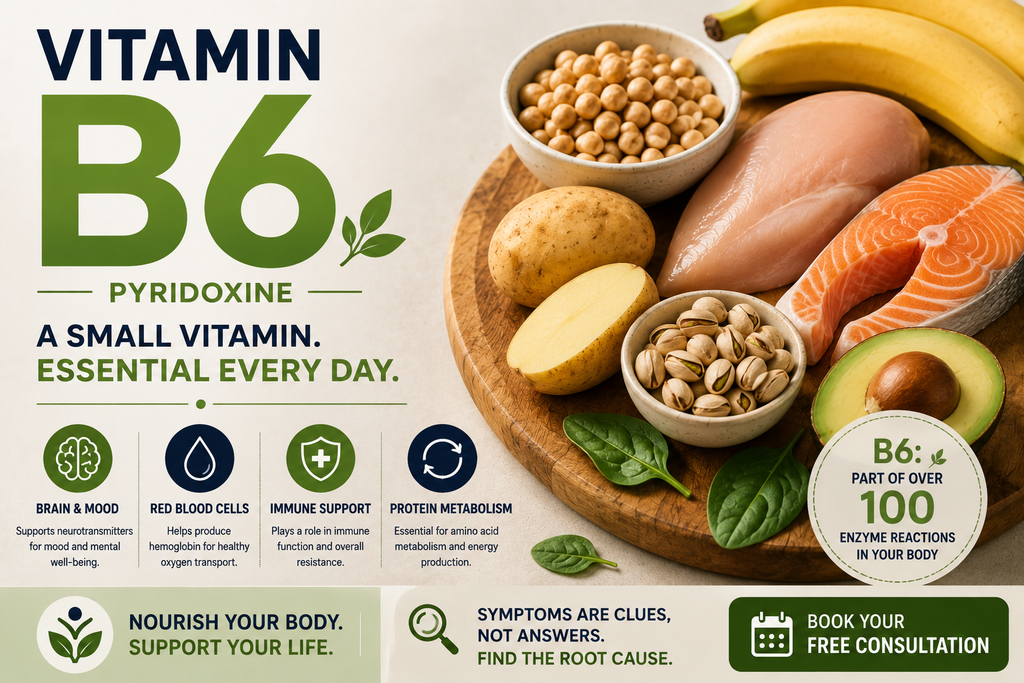
But behind the scenes, Vitamin B6 participates in more than 100 enzyme reactions—many involving protein metabolism—and contributes to your nervous system, immune function, hemoglobin production, and more.
When your body doesn’t have enough, the effects can show up in surprisingly different places.
So instead of thinking of B6 as “just another B vitamin,” it may be more accurate to think of it as one of the many small tools your body continually relies upon to function normally.
First: Vitamin B6 Isn’t Actually Just One Compound
Vitamin B6 is a group of related compounds.
One of its active coenzyme forms, pyridoxal 5′-phosphate (PLP), participates in many biochemical reactions throughout the body.
These reactions help your body work with amino acids, carbohydrates, neurotransmitters, and other important compounds.
Think about what happens after you eat protein.
Your body doesn’t simply absorb a steak and magically turn it into muscle.
Protein is broken into amino acids. Those amino acids are then used, transformed, and incorporated into countless biological processes.
Vitamin B6 helps make some of that biochemical work possible.
What Might Happen When B6 Becomes Too Low?
Vitamin B6 deficiency can affect several different systems rather than producing one unmistakable symptom.
Recognized signs can include skin changes, cracks at the corners of the mouth, a swollen or sore tongue, anemia, and changes involving mood or mental function.
Severe deficiency can also affect the nervous system and, in some circumstances, contribute to seizures.
But here’s the catch: Most of those symptoms have other possible explanations.
A sore tongue isn’t automatically B6 deficiency.
Neither is fatigue.
Neither is anemia.
Neither is a skin rash.
That’s why diagnosing yourself from an online symptom checklist can send you down the wrong path.
Symptoms tell you where to start asking questions—not where to stop.
Why Can B6 Affect Your Brain?
One of the more interesting jobs of Vitamin B6 involves neurotransmitter synthesis.
Neurotransmitters are chemical messengers your nervous system uses to communicate.
B6-dependent reactions participate in the production and metabolism of neurotransmitters, including serotonin, dopamine, and GABA.
That sounds impressive—and it is biologically important.
But be careful with the conclusion.
It does not mean every case of anxiety, depression, irritability, poor sleep, or difficulty concentrating results from B6 deficiency.
The brain is enormously complicated.
Mental and neurological symptoms can involve medical conditions, medications, sleep, stress, hormones, nutrition, and many other factors.
Knowing that a nutrient participates in a pathway doesn’t prove that taking more of that nutrient will fix a symptom related to that pathway.
That distinction matters.
Your Blood Needs B6 Too
Vitamin B6 also participates in the formation of hemoglobin, the protein inside red blood cells that helps transport oxygen.
Inadequate B6 can therefore contribute to certain forms of anemia.
And anemia can potentially leave someone feeling tired, weak, or short of breath.
But again—anemia isn’t synonymous with iron deficiency.
Iron is only one possibility.
Vitamin B12 and folate can matter.
Vitamin B6 can matter.
Blood loss can matter.
Chronic diseases can matter.
Genetic conditions can matter.
Similar outcomes can originate from very different problems.
That’s why understanding the cause is more valuable than simply treating the symptom.
Who Is More Likely to Run Low?
Severe isolated B6 deficiency isn’t particularly common in people eating varied diets, but certain circumstances can increase the risk of inadequate status.
Some kidney conditions, malabsorption disorders, autoimmune diseases, alcohol dependence, and medications can affect Vitamin B6 status or metabolism.
Deficiency also doesn’t always occur alone.
Someone with generally poor nutrition may have multiple nutritional deficiencies simultaneously.
That’s an important clue.
If someone’s entire nutritional foundation is weak, identifying one low vitamin doesn’t necessarily mean you’ve found the whole problem.
Sometimes it’s simply the first piece you’ve noticed.
Where Do You Get Vitamin B6?
Fortunately, B6 isn’t confined to one unusual food.
You’ll find it in foods such as poultry, fish, potatoes and other starchy vegetables, chickpeas, bananas, and fortified foods.
A varied diet can therefore provide B6 through several different food groups.
And that’s how nutrition should ideally work.
You shouldn’t need to obsess over obtaining enormous quantities of one vitamin.
Instead, build a diet that consistently provides a broad spectrum of nutrients.
Because your metabolism doesn’t depend on B6 alone.
It depends on B6 working alongside everything else.
There’s Another Side to the B6 Story Most People Don’t Hear
People generally assume vitamins fall into two categories:
Deficient = bad.
More = better.
Vitamin B6 is a perfect example of why that logic fails.
Although B6 is essential, taking excessive supplemental amounts for extended periods can actually damage peripheral nerves.
The result can include numbness, tingling, difficulty with coordination, and other neurological problems.
Notice the irony?
People sometimes take B6 because they’re experiencing neurological symptoms—yet excessive supplemental B6 itself can produce neurological symptoms.
That’s why supplementation needs context.
Essential doesn’t mean unlimited.
Check Your Supplement Labels
There’s another practical problem.
You may be consuming more B6 than you realize.
B6 can appear in:
Multivitamins.
B-complex formulas.
Energy supplements.
Magnesium products with added B6.
Pre-workouts.
Fortified drinks.
Individual B6 supplements.
Someone could therefore be taking several products containing B6 simultaneously without intentionally choosing a high dose.
This is one reason we encourage people to look at their entire nutritional and supplement picture, not each bottle independently.
Everything adds up.
What About P5P?
If you’ve looked at Vitamin B6 supplements, you’ve probably encountered P5P, or pyridoxal 5′-phosphate.
It’s commonly marketed as the “active” form of B6 and sometimes promoted as though everyone should choose it over pyridoxine hydrochloride.
The biochemical differences between forms are real.
But the bigger question still comes first:
Why are you supplementing B6 at all?
Choosing a sophisticated form of something you don’t need doesn’t make the strategy more personalized.
It simply makes the supplement different.
Your Body Isn’t Waiting for the Next Bottle
Here’s the cycle many people fall into:
They experience fatigue.
They try iron.
Then B12.
Then Vitamin D.
They develop tingling.
Now they read about B6.
They buy P5P.
Someone recommends magnesium.
They add that too.
Eventually, the supplement routine becomes more complicated than the original health problem.
But complexity isn’t the same as precision.
Sometimes the smartest move isn’t adding something.
It’s figuring out why the problem is happening.
This Is Where the Conversation Changes at Systemic Body
At Systemic Body, nutrition is an important part of what we investigate—but we don’t automatically blame every symptom on nutrition.
Instead, we consider potential contributing factors through our 6 Root Causes: Nutrition, Toxicity, Alignment, Infections, Emotions, and Mind.
That changes the question.
Instead of: “Which vitamin treats my symptom?”
We want to understand: “What factors could be creating or contributing to this symptom in this particular person?”
Maybe B6 deserves attention.
Maybe another nutrient does.
Maybe multiple nutritional factors are involved.
Or maybe the biggest contributor isn’t nutritional at all.
Personalization means being willing to find out instead of assuming.
Your Symptoms Aren’t a Shopping List
Fatigue doesn’t automatically mean iron.
Tingling doesn’t automatically mean B6.
Muscle cramps don’t automatically mean magnesium.
And low mood doesn’t automatically mean you’re missing a particular neurotransmitter nutrient.
Symptoms are information.
Use them as clues—not instructions for what supplement to buy next.
That’s how you begin moving away from trial-and-error health care.
Before You Try Another Supplement…
Ask yourself something simple:
How many things have I already tried without understanding the actual problem?
If the answer is “a lot,” maybe another bottle isn’t what you’re missing.
Vitamin B6 is unquestionably important.
But knowing that B6 matters isn’t the same thing as knowing whether you need more B6.
Your body deserves more than guesswork.
Find Out What YOUR Body Needs
If you’ve spent months or years jumping between diets, vitamins, supplements, and protocols while the same problems keep returning, consider approaching your health differently.
At Systemic Body, we look beyond isolated symptoms to help identify potential contributing factors and develop a more individualized approach.
Healthfully,
Systemic Body
Note: I write every post; all this info comes from 10 years of daily testing for my own body.