Vitamin B5 doesn’t get much attention. There are no trendy conversations about pantothenic acid, and most people have probably never wondered whether they’re getting enough of it.
Yet Vitamin B5 participates in one of the most fundamental jobs your body performs: converting the food you eat into compounds your cells can actually use.
Fortunately, true Vitamin B5 deficiency is very rare. But understanding B5 reveals something important about nutrition: your body depends on nutrients you’ve probably never thought about.
So, What Exactly Is Vitamin B5?
Vitamin B5 is better known as pantothenic acid.
Its name actually comes from the Greek word pantos, meaning “everywhere”—an appropriate name because B5 is widely distributed throughout foods.
Inside your body, pantothenic acid becomes part of coenzyme A (CoA), a compound involved in numerous metabolic reactions.
CoA helps your body metabolize carbohydrates, fats, and proteins. It also participates in the synthesis of fatty acids and other biologically important compounds.
Put simply: B5 helps your metabolism do its job.
And metabolism isn’t just about losing weight. It’s the enormous collection of chemical reactions keeping you alive every second.
Imagine Eating Without Being Able to Properly Use What You Ate
You finish a meal containing protein, carbohydrates, and fat.
That’s only step one.
Your digestive system has to break those foods down. Nutrients have to be absorbed. Then your cells have to process those nutrients through complex biochemical pathways.
Vitamin B5 participates in that machinery.
This is why we shouldn’t evaluate nutrition exclusively by asking: “Am I eating enough?”
We also need to consider: “Does my diet provide the micronutrients my metabolism requires?”
You can consume calories without necessarily consuming an optimally varied diet.
Is Vitamin B5 Deficiency Common?
No. In fact, true pantothenic acid deficiency is extremely rare, largely because B5 occurs in such a wide variety of foods.
Most documented deficiency has occurred in unusual circumstances, including severe malnutrition or experimental settings.
That means someone experiencing fatigue shouldn’t immediately conclude: “I’m deficient in B5.”
That’s not how nutritional diagnosis works.
When true deficiency has occurred, reported symptoms have included fatigue, irritability, headache, gastrointestinal disturbances, and numbness or burning sensations in the hands and feet.
But none of these symptoms belongs exclusively to Vitamin B5 deficiency.
Fatigue alone could have dozens of explanations.
So could tingling.
So could digestive problems.
Recognizing yourself in a symptom list doesn’t mean you’ve discovered the cause.
The Strange “Burning Feet” Connection
One of the more interesting symptoms historically associated with severe pantothenic acid deficiency is a sensation described as “burning feet.”
That doesn’t mean B5 is the answer whenever someone’s feet burn or tingle.
Far from it.
Burning or tingling sensations can have neurological, metabolic, circulatory, medication-related, nutritional, and other causes.
Persistent or unexplained neurological symptoms deserve appropriate medical evaluation.
But the example illustrates something fascinating:
Even a vitamin required in relatively small quantities can participate in processes affecting how you feel.
Micronutrients are called “micro” because of the amounts required—not because their biological roles are insignificant.
You Probably Already Eat Vitamin B5
Here’s the good news.
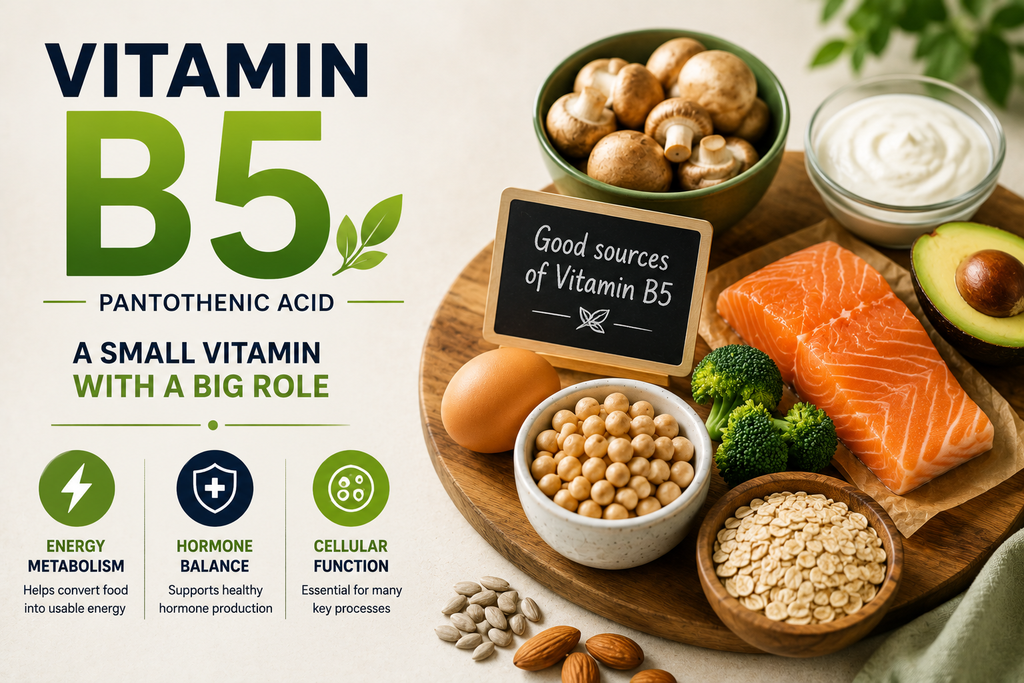
Pantothenic acid is found across an enormous range of foods, including meat, poultry, eggs, dairy products, whole grains, mushrooms, avocados, potatoes, broccoli, legumes, and other foods.
That’s another reason isolated B5 deficiency is uncommon.
You don’t need to find some exotic “B5 superfood.”
A varied diet naturally gives you multiple opportunities to obtain it.
And that’s really the bigger nutritional lesson.
Instead of obsessing over one food containing enormous quantities of one vitamin, build a diet that provides a broad spectrum of nutrients.
Your body needs the spectrum.
B5 Is Part of a Much Bigger Team
Pantothenic acid helps form coenzyme A.
But B5 doesn’t operate inside a nutritional vacuum.
Energy metabolism involves numerous B vitamins.
Minerals participate.
Amino acids participate.
Hormones participate.
Your mitochondria participate.
Your digestive system determines what gets absorbed in the first place.
Your liver processes nutrients.
Your cells ultimately have to use them.
This interconnectedness is why nutrition can become frustrating when people approach it as:
Symptom → Google → Vitamin → Supplement.
Human physiology is rarely that simple.
Then Why Are B5 Supplements Everywhere?
Because being essential and needing supplementation are two different things.
Vitamin B5 appears in multivitamins and B-complex products, and individual pantothenic acid supplements are also available.
You may also encounter pantethine, a derivative related to pantothenic acid, marketed for different purposes.
But the fact that a supplement exists doesn’t mean your body needs additional amounts.
And because genuine deficiency is uncommon, taking B5 simply because you’re tired isn’t necessarily addressing anything.
Before asking which supplement to buy, determine why you’re considering one.
What About Vitamin B5 for Acne?
This deserves its own section because B5 is sometimes heavily promoted online for acne and oily skin.
There has been research exploring pantothenic-acid-containing supplements and acne, but the evidence isn’t strong enough to conclude that ordinary acne generally results from B5 deficiency or that high-dose B5 should be considered a standard acne treatment.
Acne is multifactorial.
Hormones can matter.
Genetics can matter.
Skin biology matters.
Medications and products can matter.
Other factors can matter.
Calling acne a “Vitamin B5 deficiency” dramatically oversimplifies the problem.
A biological theory isn’t automatically a proven treatment.
The Supplement Trap Is Easy to Fall Into
Here’s how it usually happens.
You don’t feel right.
You discover a nutrient connected to one of your symptoms.
The explanation sounds convincing.
You order it.
Maybe you feel different. Maybe you don’t.
Then another article introduces another nutrient.
Six months later, your morning routine looks like this:
B-complex.
Magnesium.
Zinc.
Vitamin D.
Vitamin C.
Omega-3.
Probiotic.
Three herbs.
And now B5.
Yet nobody has answered the original question:
Why aren’t you feeling your best?
Adding another supplement can make you feel like you’re taking action.
But taking action and identifying the problem aren’t necessarily the same thing.
What If Nutrition Isn’t the Only Piece?
This is where our philosophy at Systemic Body becomes different.
We take nutrition seriously.
Very seriously.
But we don’t assume every symptom is caused by a nutrient deficiency.
Our approach considers potential contributing factors through our 6 Root Causes: Nutrition, Toxicity, Alignment, Infections, Emotions, and Mind.
Perhaps your nutritional intake needs improvement.
Perhaps several nutrients deserve consideration rather than one.
Perhaps digestion or absorption matters.
Or perhaps the factor keeping you stuck isn’t primarily nutritional.
That’s exactly why personalization matters.
Two people can say: “I’m exhausted all the time.”
and potentially have completely different explanations.
Giving both people Vitamin B5 because B5 participates in energy metabolism wouldn’t be personalized care.
It would be guessing.
Don’t Confuse an Important Nutrient With the Answer to Every Problem
Vitamin B5 is essential.
Your metabolism requires it.
Your body uses it to make coenzyme A.
You need to obtain pantothenic acid through your diet.
All of that is true.
But this does not mean B5 supplementation will automatically increase your energy, fix your skin, eliminate tingling, or solve unexplained symptoms.
That’s where nutritional education needs to become individualized.
The question isn’t: “Is Vitamin B5 important?”
We already know it is.
The question is: “What does YOUR body actually need?”
And you won’t answer that by continually adding random supplements.
You’ve Tried Guessing. Try a Different Approach.
If you’ve spent months searching for symptoms, changing diets, and buying supplements without finding the answers you’re looking for, maybe it’s time to stop treating your health like trial and error.
At Systemic Body, we look beyond individual vitamins and isolated symptoms to consider the bigger picture and build a more customized approach.
You don’t need every supplement on the shelf.
You need to understand what factors may actually be holding you back.
Ready to Look Deeper?
Your symptoms are worth investigating—not simply covering up with another product.
Maybe it’s time for a more personalized approach.
Healthfully,
Systemic Body
Note: I write every post; all this info comes from 10 years of daily testing for my own body.