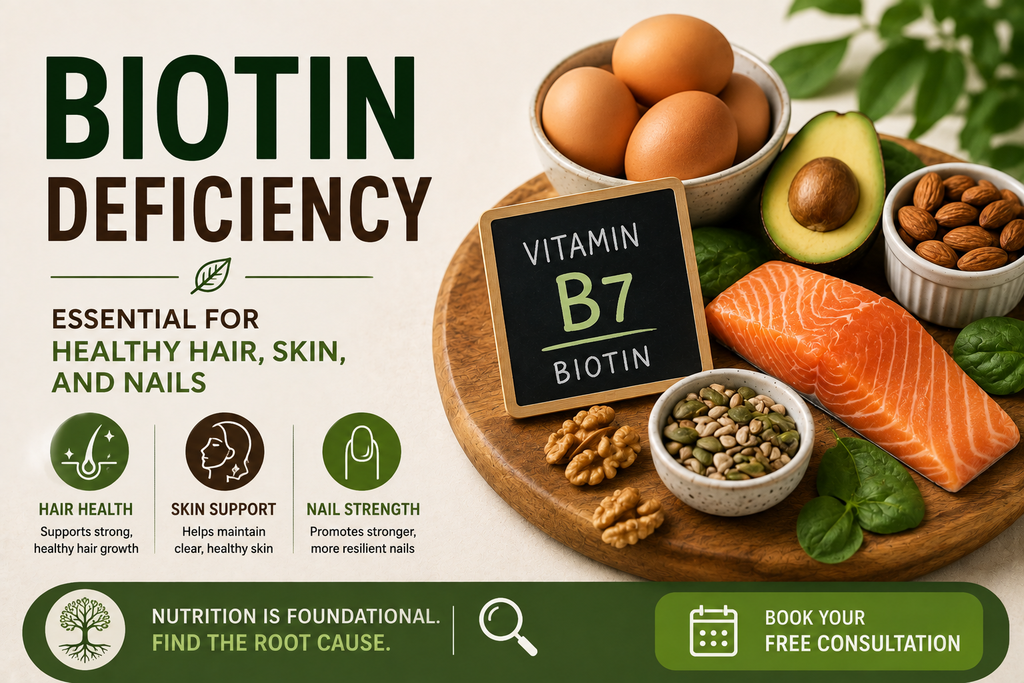
Biotin is everywhere in the supplement industry. It’s added to gummies, shampoos, hair formulas, nail products, and beauty supplements—usually accompanied by promises of thicker hair, stronger nails, and healthier skin.
But here’s where things get interesting:
Biotin is genuinely essential, and true biotin deficiency can affect your hair, skin, and nervous system. Yet taking extra biotin when you aren’t deficient doesn’t automatically give you better hair.
Understanding that difference can save you from treating the wrong problem.
Biotin Isn’t Really a Beauty Vitamin
Vitamin B7, better known as biotin, has been turned into a beauty ingredient.
Your body sees it very differently.
Biotin acts as a cofactor for several enzymes called carboxylases, which participate in the metabolism of fatty acids, glucose, and amino acids.
In other words, B7 isn’t sitting around waiting to make your hair prettier.
It’s participating in fundamental cellular metabolism.
Hair and skin changes can occur when someone becomes deficient, but those visible symptoms are consequences of a broader nutritional problem—not biotin’s sole purpose.
What Does Real Biotin Deficiency Look Like?
True biotin deficiency is considered rare, particularly in people eating varied diets.
When it does occur, one of the more recognizable signs can be thinning hair or hair loss.
Skin changes can also develop, including a red, scaly rash—often around areas such as the eyes, nose, and mouth.
But deficiency doesn’t necessarily stop with appearance.
More significant deficiency can produce neurological symptoms such as lethargy, depression, numbness or tingling, and other nervous-system changes.
Severe cases can become much more serious.
So yes: Biotin deficiency can affect hair.
But reducing biotin to a “hair-growth vitamin” misses most of the story.
Your Hair Is Falling Out. Does That Mean You Need Biotin?
This is probably the most important question in this entire article.
No—not automatically.
Hair loss can have many possible causes.
Iron status can matter.
Thyroid problems can matter.
Hormonal changes can matter.
Significant stress or illness can matter.
Certain medications can matter.
Rapid weight loss can matter.
Protein intake can matter.
Genetics can matter.
Other nutritional deficiencies can matter.
And yes, biotin deficiency can matter too.
But if ten different problems can produce hair loss, buying biotin because your hair is falling out isn’t identifying the cause.
It’s choosing one possibility and hoping you’re right.
This Is Where Supplement Marketing Gets Ahead of the Evidence
Walk into almost any pharmacy, and you’ll find biotin products advertising:
Hair. Skin. Nails.
Often in very large doses.
This can create the impression that if biotin deficiency causes hair problems, taking more biotin must produce better hair.
That’s not necessarily how biology works.
Correcting a genuine deficiency and taking huge amounts when you’re already getting enough are two very different situations.
If your car is low on oil, adding oil helps.
If it already has exactly the amount it needs, pouring several more bottles into the engine doesn’t make the engine healthier.
Nutrition often works the same way.
Where Does Biotin Come From?
Biotin occurs naturally in many foods.
Sources include eggs, meat and organ meats, fish, nuts, seeds, sweet potatoes, and certain vegetables.
Your intestinal bacteria can also produce biotin, although exactly how much this contributes to human nutritional requirements isn’t completely clear.
Because biotin is distributed across many foods and your body only requires relatively small amounts, severe dietary deficiency is uncommon.
That’s good news.
For most people, a varied diet does much more for nutritional coverage than obsessing over one “superfood.”
Before You Buy 10,000 mcg of Biotin, Read This
Many beauty supplements contain biotin doses dramatically higher than typical daily nutritional requirements.
And there’s an important problem that deserves much more attention:
High-dose biotin can interfere with certain laboratory tests.
Biotin can distort results from some laboratory testing methods, potentially producing falsely high or falsely low results depending on the test.
This can affect tests involving things such as thyroid hormones and certain cardiac markers, among others.
That means your “harmless hair vitamin” could potentially complicate the interpretation of important medical testing.
If you’re taking high-dose biotin and you’re having blood work performed, tell your healthcare professional and the laboratory about your supplements.
Don’t assume supplements are irrelevant just because they’re available without a prescription.
Why Isn’t My Biotin Working?
Maybe you’ve already tried it.
You saw more hair in the shower.
You bought biotin gummies.
One month passed.
Then two.
You’re still concerned.
So you buy a stronger formula.
But consider the obvious question:
What if biotin was never the problem?
You can’t correct an iron problem with biotin.
You can’t correct a thyroid disorder with biotin.
You can’t correct inadequate protein intake with biotin.
And you can’t correct every form of genetic hair loss with biotin.
This is why blindly supplementing based on symptoms can become frustrating.
The right supplement for the wrong problem is still the wrong solution.
Your Hair Can Be a Clue About the Bigger Picture
Hair isn’t essential for survival.
When the body is dealing with major nutritional shortages, illness, significant physiological stress, or hormonal changes, hair growth can sometimes be affected.
That’s one reason hair changes deserve attention.
Not because they automatically reveal one deficiency.
But because they may give you a reason to investigate what else is happening inside the body.
Instead of immediately asking: “What can I take for my hair?”
try asking: “Why did my hair start changing in the first place?”
That’s a much more useful question.
One Symptom Doesn’t Equal One Nutrient
This principle goes far beyond biotin.
Fatigue doesn’t automatically mean iron.
Tingling doesn’t automatically mean B6.
Muscle cramps don’t automatically mean magnesium.
Hair loss doesn’t automatically mean biotin.
The human body is far too interconnected for that.
Sometimes several nutritional factors are involved simultaneously.
Sometimes digestion or absorption contributes.
Sometimes the primary issue isn’t nutritional at all.
Symptoms provide clues. The investigation finds the explanation.
That’s Why We Don’t Start With the Supplement
At Systemic Body, we don’t see hair loss and immediately hand everyone biotin.
Our approach considers potential contributing factors through our 6 Root Causes: Nutrition, Toxicity, Alignment, Infections, Emotions, and Mind.
Nutrition may deserve attention.
Perhaps protein intake needs examination.
Perhaps micronutrients deserve consideration.
Perhaps another factor stands out entirely.
The objective isn’t to find a supplement.
It’s to better understand your situation.
Because two people can walk in with the same symptom and potentially have very different contributing factors.
Your Supplement Cabinet Shouldn’t Be Your Diagnostic Tool
If you’ve accumulated bottle after bottle because every new symptom sends you searching for another deficiency, ask yourself:
Do I actually know what I’m trying to correct?
If not, buying another supplement may simply continue the experiment.
Biotin is essential.
True deficiency deserves correction.
But that doesn’t mean everyone experiencing hair or skin problems needs more biotin.
Sometimes the smartest nutritional decision isn’t adding another nutrient—it’s figuring out what’s actually missing.
Stop Treating Your Hair. Start Investigating Why It Changed.
If you’re dealing with persistent hair, skin, energy, or other health concerns and you’ve already tried supplements without getting the results you expected, it may be time for a different approach.
At Systemic Body, we look beyond the obvious symptom to consider the bigger picture and help build a more individualized strategy.
Healthfully,
Systemic Body
Note: I write every post; all this info comes from 10 years of daily testing for my own body.