When people think about essential nutrients, vitamins, and minerals, such as magnesium, calcium, vitamin D, and potassium, they usually come to mind.
Sulfur rarely does.
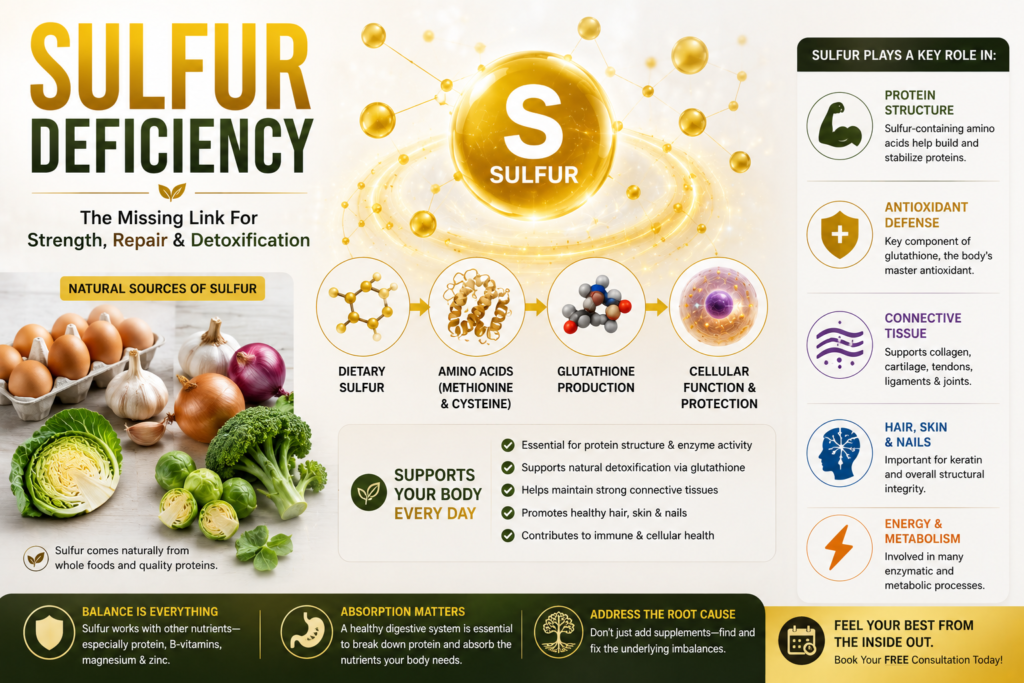
Yet sulfur is an important element found throughout the human body. It is incorporated into certain amino acids, proteins, enzymes, vitamins, antioxidants, and connective tissues.
Your body uses sulfur-containing compounds in processes involving:
- Protein structure
- Antioxidant defenses
- Connective tissue
- Cellular metabolism
- Enzyme activity
- Hair, skin, and nails
However, sulfur is different from nutrients such as iron or vitamin B12.
There is no commonly used clinical diagnosis of dietary “sulfur deficiency” in otherwise healthy adults, and there isn’t a standard blood test used to diagnose sulfur deficiency from diet.
Instead, the body obtains most of the sulfur it needs through sulfur-containing amino acids, particularly methionine and cysteine, found in dietary protein.
So the better question isn’t necessarily: “Am I sulfur deficient?”
It may be: “Am I consuming and utilizing enough sulfur-containing nutrients to support the processes that depend on them?”
Where Does The Body Get Sulfur?
Most dietary sulfur doesn’t come from a supplement labeled “sulfur.”
It comes naturally from food.
Two particularly important sulfur-containing amino acids are:
Methionine
Methionine is an essential amino acid, meaning your body cannot manufacture enough of it on its own and must obtain it through food.
Cysteine
Cysteine also contains sulfur.
Unlike methionine, cysteine can be produced by the body under appropriate conditions, using methionine as part of the pathway.
These amino acids are incorporated into proteins and other biologically important molecules throughout the body.
Sulfur is also present in compounds found in foods such as garlic, onions, cruciferous vegetables, eggs, meat, and fish.
What Does Sulfur Actually Do In The Body?
Sulfur isn’t responsible for only one function.
It becomes part of molecules that perform very different jobs throughout the body.
1. Supports Protein Structure
Proteins aren’t simply chains of amino acids.
They must fold into specific shapes to function correctly.
The sulfur-containing amino acid cysteine can form disulfide bonds, which help stabilize the structure of many proteins.
These bonds are particularly important in structural proteins such as keratin, which is abundant in hair and nails.
2. Contributes To Glutathione Production
One of sulfur’s most interesting roles involves glutathione.
Glutathione is an antioxidant produced naturally by the body from three amino acids:
- Cysteine
- Glutamate
- Glycine
Cysteine contains sulfur and can be an important factor in glutathione synthesis.
Glutathione participates in the body’s antioxidant defenses and helps cells manage oxidative stress.
This is one reason sulfur-containing amino acids are frequently discussed in relation to the body’s natural detoxification systems.
However, “detoxification” isn’t one single process or organ.
Your liver, kidneys, digestive system, lungs, enzymes, antioxidants, and other biological systems all participate in processing and eliminating different compounds.
3. Supports Connective Tissue
Sulfur-containing compounds are present in tissues throughout the body.
Sulfur is found in molecules associated with:
- Cartilage
- Tendons
- Ligaments
- Skin
- Other connective tissues
This doesn’t mean consuming more sulfur automatically repairs joints or connective tissue.
It means sulfur is one of the many building blocks involved in normal tissue structure.
4. Hair, Skin & Nails
Keratin is an important structural protein found in:
- Hair
- Skin
- Nails
Its structure contains sulfur-containing amino acids, particularly cysteine.
The disulfide bonds formed between cysteine residues help provide keratin with strength and stability.
This is one reason sulfur has long been associated with hair, skin, and nail health.
But brittle nails, hair loss, or skin problems should not automatically be diagnosed as sulfur deficiency.
Protein intake, iron, zinc, thyroid function, hormones, illness, genetics, and many other factors can produce similar changes.
5. Sulfur & Cellular Metabolism
Sulfur is incorporated into several biologically active molecules involved in normal metabolism.
For example, the vitamins thiamine (vitamin B1) and biotin (vitamin B7) contain sulfur within their chemical structures.
Sulfur-containing compounds also participate in numerous enzymatic and cellular pathways.
This demonstrates an important nutritional principle:
Nutrients don’t work independently.
Sulfur metabolism interacts with amino acids, vitamins, minerals, enzymes, and antioxidant systems throughout the body.
Can You Actually Become Sulfur Deficient?
This is where sulfur differs significantly from something like vitamin D or magnesium.
There isn’t an established recommended dietary allowance specifically for elemental sulfur.
Instead, nutritional requirements are largely addressed through adequate consumption of sulfur-containing amino acids from dietary protein.
For someone consuming adequate amounts of varied protein, insufficient sulfur intake is generally unlikely.
A potential concern would therefore be more relevant in situations involving:
- Very inadequate protein intake
- Severe malnutrition
- Significant digestive or absorption problems
- Highly restrictive diets
- Certain metabolic disorders
In these circumstances, sulfur wouldn’t necessarily be the only nutrient affected.
Multiple amino acids, vitamins, minerals, and other nutrients could potentially become inadequate at the same time.
Are You Eating Enough Sulfur-Rich Foods?
Sulfur occurs naturally in many everyday foods.
Animal Foods
Many protein-rich animal foods provide methionine and cysteine.
Examples include:
- Eggs
- Beef
- Chicken
- Turkey
- Fish
- Seafood
- Milk
- Yogurt
- Cheese
Eggs are particularly well known for containing sulfur compounds, which also contribute to their characteristic smell.
Cruciferous Vegetables
Vegetables from the cruciferous family contain sulfur-containing compounds known as glucosinolates.
Examples include:
- Broccoli
- Cauliflower
- Brussels sprouts
- Cabbage
- Kale
- Bok choy
When these vegetables are chopped or chewed, their sulfur-containing compounds can be converted into other biologically active compounds.
Garlic & Onions
Garlic and onions belong to the Allium family and contain distinctive organosulfur compounds.
These sulfur compounds are responsible for much of their characteristic aroma and flavor.
Other members of this family include:
- Leeks
- Shallots
- Chives
Legumes, Nuts & Seeds
Plant foods can also contribute sulfur-containing amino acids.
Examples include:
- Lentils
- Beans
- Chickpeas
- Nuts
- Seeds
For people eating predominantly plant-based diets, consuming a varied selection of protein sources helps provide the full range of essential amino acids the body requires.
What About MSM?
You may have seen MSM (methylsulfonylmethane) marketed as a sulfur supplement.
MSM is a sulfur-containing compound commonly sold as a dietary supplement, particularly for joint-related purposes.
But MSM shouldn’t be confused with correcting a medically established “sulfur deficiency.”
The body primarily meets its nutritional sulfur requirements through sulfur-containing amino acids and normal dietary intake.
A supplement should therefore have a specific reason behind it rather than being taken simply because someone assumes symptoms mean they are “low in sulfur.”
Don’t Forget About Digestion & Absorption
Eating nutritious food is only the first step.
The digestive system must break dietary proteins down into amino acids and small peptides so they can be absorbed and used.
If someone has significant malabsorption or another digestive disorder, simply adding increasingly large amounts of nutrient-rich food may not solve the underlying issue.
This becomes particularly important when multiple nutritional deficiencies appear together.
Instead of looking at every nutrient independently:
Low B12 → Take B12
Low magnesium → Take magnesium
Low iron → Take iron
It can be useful to ask whether there is a common reason multiple nutrients aren’t being adequately consumed, absorbed, or maintained.
Sulfur Is Part Of A Bigger Nutritional System
Sulfur provides a perfect example of why nutrition shouldn’t be reduced to individual supplements.
Your body needs:
Protein provides amino acids.
Methionine and cysteine supply sulfur-containing building blocks.
Vitamin B6, folate, and vitamin B12 support interconnected amino-acid metabolism.
Glycine and glutamate along with cysteine to produce glutathione.
The digestive system breaks down and absorbs nutrients.
The liver and kidneys process metabolites and maintain normal physiology.
Everything is connected. This is systemic body for a reason.
Should You Take A Sulfur Supplement?
For most people, the priority should be ensuring adequate overall nutrition rather than trying to directly “replace sulfur.”
A nutrient-dense diet containing sufficient protein and a variety of whole foods naturally provides sulfur-containing compounds.
Foods worth including can be:
- Eggs
- Meat
- Fish
- Dairy
- Legumes
- Garlic
- Onions
- Broccoli
- Cauliflower
- Brussels sprouts
- Cabbage
- Nuts and seeds
Whether a specific sulfur-containing supplement, such as MSM or N-acetylcysteine (NAC), is appropriate is a separate question and depends on the reason it is being considered.
Supplements can have side effects and interactions, and shouldn’t automatically be treated as substitutes for identifying the underlying nutritional or medical issue.
Stop Looking At Nutrients One At A Time
When someone experiences fatigue, weak hair or nails, skin problems, joint discomfort, or other nonspecific symptoms, it’s tempting to search for the one missing nutrient responsible.
The human body is rarely that simple.
There isn’t a reliable collection of symptoms that can diagnose “sulfur deficiency” on its own.
Instead, look at the bigger picture:
Are you consuming enough high-quality protein?
Are you eating a varied, nutrient-dense diet?
Is your digestive system absorbing nutrients properly?
Are multiple deficiencies appearing together?
Is there an underlying condition affecting nutrient metabolism?
At Systemic Body, we focus on understanding these relationships rather than simply matching every symptom with another supplement.
The goal is to determine what your body actually needs, why an imbalance may be occurring, and which underlying factors need to be addressed.
Healthfully,
Systemic Body
Note: I write every post; all this info comes from 10 years of daily testing for my own body.