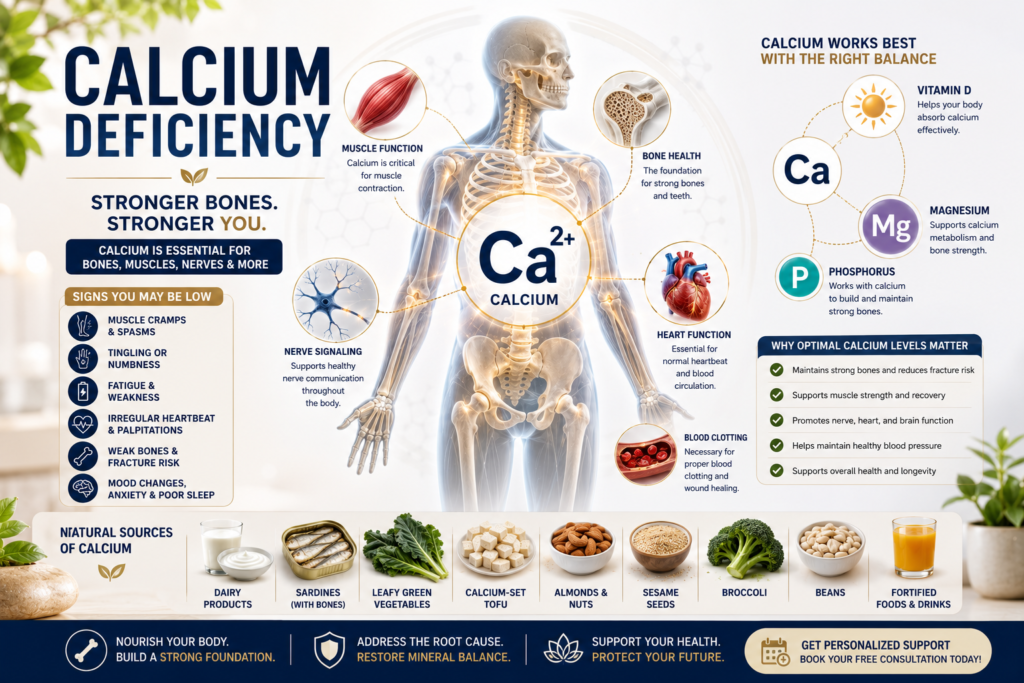
Calcium is usually associated with strong bones and teeth, but that’s only part of its role in the body.
Your muscles need calcium to contract. Your nerves use calcium for normal communication. Your heart depends on carefully regulated calcium levels, and calcium is also involved in blood clotting and numerous cellular processes.
When calcium levels in the blood become abnormally low, the condition is known as hypocalcemia.
But there’s an important distinction:
Low calcium in your blood doesn’t necessarily mean you simply aren’t eating enough calcium.
Your body tightly regulates blood calcium. Vitamin D, parathyroid hormone, the kidneys, digestive system, bones, magnesium, and dietary intake all contribute to maintaining that balance.
So when calcium becomes low, the goal shouldn’t simply be: “Take more calcium.”
The better question is: “Why isn’t my body maintaining normal calcium levels?”
Why Is Calcium So Important?
Approximately 99% of the calcium in your body is stored in your bones and teeth.
The remaining amount circulates in the blood and exists within other tissues, where it performs functions that are essential for life.
Bones & Teeth
Your skeleton isn’t simply a rigid structure.
Bone is a living tissue that is constantly being broken down and rebuilt.
Calcium provides an important structural component of bones and teeth, but maintaining healthy bones also depends on many other factors, including:
- Vitamin D
- Protein
- Magnesium
- Phosphorus
- Hormones
- Physical activity
Calcium, therefore, shouldn’t be considered in isolation.
Muscle Contraction
Every time you move your arm, walk, exercise, or even breathe, calcium participates in the process that allows muscles to contract.
Abnormal calcium levels can therefore affect normal muscle function.
Nerve Signaling
Calcium plays an important role in communication between nerve cells.
When calcium becomes significantly low, nerves and muscles can become unusually excitable, potentially contributing to tingling, twitching, or muscle spasms.
Heart Function
The heart is a muscle with its own electrical system.
Calcium participates in both the electrical activity and the contraction of the heart muscle.
Significant disturbances in calcium levels can therefore affect normal heart rhythm and function.
Blood Clotting
Calcium is also required for several steps involved in normal blood coagulation.
This is another example of why calcium does much more than simply build bones.
What Are The Signs Of Calcium Deficiency?
Mild hypocalcemia may cause a few noticeable symptoms.
When calcium becomes significantly low, symptoms can include:
Tingling & Numbness
Tingling may occur around the lips, fingers, or feet.
This happens because low calcium can increase the excitability of nerves.
Muscle Cramps
Muscle cramps, twitching, stiffness, or spasms can occur when calcium levels become significantly abnormal.
Muscle Weakness
Because calcium is essential for muscle contraction, disturbances in calcium balance may interfere with normal muscle function.
Fatigue
Fatigue can accompany calcium abnormalities, although fatigue has many possible causes and shouldn’t automatically be attributed to calcium.
Abnormal Heart Rhythm
Severe hypocalcemia can affect the electrical activity of the heart and contribute to abnormal rhythms.
Seizures
Extremely low calcium can affect the nervous system enough to cause seizures and other serious neurological symptoms.
Why Does Calcium Become Low?
Calcium regulation is more complicated than simply comparing how much calcium you eat with how much your body needs.
Several different systems determine your calcium status.
1. Not Enough Calcium In The Diet
Long-term inadequate calcium intake can negatively affect bone health.
Foods naturally containing or commonly providing calcium include:
- Dairy products
- Meat like beef, chicken
- Sardines with bones
- Canned salmon with bones
- Certain leafy green vegetables
- Calcium-set tofu (not recommended)
- Fortified foods (not recommended)
However, dietary intake is only one part of the picture.
Your body must also be able to absorb and regulate that calcium.
2. Vitamin D Deficiency
Vitamin D and calcium are closely connected.
One of vitamin D’s major functions is helping the intestines absorb calcium.
If vitamin D is inadequate, the body may have difficulty absorbing enough calcium from food even when calcium intake itself appears reasonable.
This means that in some cases, addressing calcium without looking at vitamin D status misses an important part of the problem.
3. Magnesium Deficiency
Magnesium also participates in calcium regulation.
Significant magnesium deficiency can interfere with the normal secretion and action of parathyroid hormone (PTH), one of the body’s primary calcium-regulating hormones.
As a result, severe magnesium deficiency can sometimes contribute to hypocalcemia.
Again, nutrients don’t operate independently.
Calcium, magnesium, vitamin D, phosphorus, and hormones all interact.
4. Parathyroid Problems
The parathyroid glands are small glands located in the neck that play a major role in controlling blood calcium.
When blood calcium falls, parathyroid hormone normally helps bring it back toward the appropriate range.
If the parathyroid glands don’t produce enough PTH—a condition called hypoparathyroidism—blood calcium can fall.
This can sometimes occur after neck or thyroid surgery, although there are other causes as well.
In this situation, simply eating additional calcium doesn’t necessarily address the complete problem.
5. Kidney Problems
Your kidneys participate in vitamin D activation and help regulate minerals such as calcium and phosphorus.
Significant kidney dysfunction can therefore disturb normal mineral metabolism.
Chronic kidney disease can produce complex changes involving:
- Calcium
- Phosphorus
- Vitamin D
- Parathyroid hormone
These situations require medical management rather than simply adding calcium supplements.
6. Poor Digestive Absorption
You can consume a nutrient without necessarily absorbing all of it.
Conditions affecting the digestive tract may reduce calcium absorption.
These can include:
- Celiac disease
- Crohn’s disease
- Certain gastrointestinal surgeries
- Other malabsorption disorders
Vitamin D deficiency can further reduce calcium absorption.
If several nutritional deficiencies appear together, investigating digestive function may be particularly important.
7. Certain Medications
Some medications can influence calcium levels directly or indirectly through their effects on:
- Vitamin D metabolism
- Kidney function
- Bone metabolism
- Magnesium levels
- Calcium absorption
If blood calcium is repeatedly abnormal, medications should be considered as part of the overall evaluation.
Medication changes should be discussed with the prescribing healthcare professional.
Calcium, Vitamin D & Magnesium: Think Of Them Together
Rather than looking at calcium as an isolated nutrient, it can be helpful to understand some of its major relationships.
Calcium provides structural material for bones and participates in muscle, nerve, and cellular function.
Vitamin D helps the digestive system absorb calcium and participates in calcium regulation.
Magnesium contributes to normal parathyroid hormone function and vitamin D metabolism.
Parathyroid hormone helps regulate blood calcium by influencing the bones, kidneys, and vitamin D system.
The body constantly adjusts these systems to keep blood calcium within a relatively narrow range.
This is why a calcium problem isn’t always simply a calcium intake problem.
How Do You Correct Calcium Deficiency?
Treatment depends on what is actually causing the deficiency.
If dietary intake is inadequate, increasing calcium-rich foods may be appropriate.
Whole-food options include:
Dairy Products
Milk, yogurt, and cheese can provide substantial amounts of highly absorbable calcium.
Sardines & Salmon With Bones
Soft edible fish bones are naturally rich in calcium.
Leafy Green Vegetables
Certain greens can contribute calcium, although absorption varies considerably between vegetables.
Should You Take A Calcium Supplement?
Not automatically.
Calcium supplementation may be useful for some people who cannot obtain adequate amounts through diet or who have specific medical indications.
But taking large amounts of calcium without understanding your overall nutritional and medical situation isn’t necessarily beneficial.
The appropriate approach can depend on:
- Dietary calcium intake
- Vitamin D status
- Magnesium status
- Kidney function
- Medications
- Digestive health
- Age
- Bone health
- The underlying cause of low calcium
More isn’t always better.
How Is Calcium Deficiency Tested?
Calcium deficiencies are rare. We will test you with energetic testing and let you know. Calcium is usually not the problem; it’s magnesium.
Book an appointment below and let’s start treating you!
When Is Low Calcium An Emergency?
Severe hypocalcemia can become medically serious.
Seek urgent medical attention for symptoms such as:
- Severe muscle spasms
- Seizures
- Fainting
- Significant confusion
- Difficulty breathing
- Serious heart palpitations or abnormal heart rhythm
Severe hypocalcemia may require medical calcium replacement and monitoring.
Don’t Just Replace Calcium—Understand Why It’s Low
If calcium is low, the obvious reaction is:
“I need more calcium.”
Sometimes that’s correct.
But sometimes the real problem is somewhere else.
You could have inadequate vitamin D.
You could have a significant magnesium deficiency.
Your digestive system may not be absorbing nutrients properly.
Your parathyroid glands may not be regulating calcium normally.
Your kidneys may be affecting mineral balance.
Or your dietary intake may genuinely be inadequate.
The important question is therefore not only: “How much calcium am I getting?”
It’s: “Why isn’t my body maintaining the calcium it needs?”
At Systemic Body, we focus on identifying the nutritional and systemic factors contributing to an imbalance rather than simply matching every symptom with another supplement.
Understanding the underlying cause allows you to develop a much more targeted approach to restoring nutritional balance.
Healthfully,
Systemic Body
Note: I write every post; all this info comes from 10 years of daily testing for my own body.