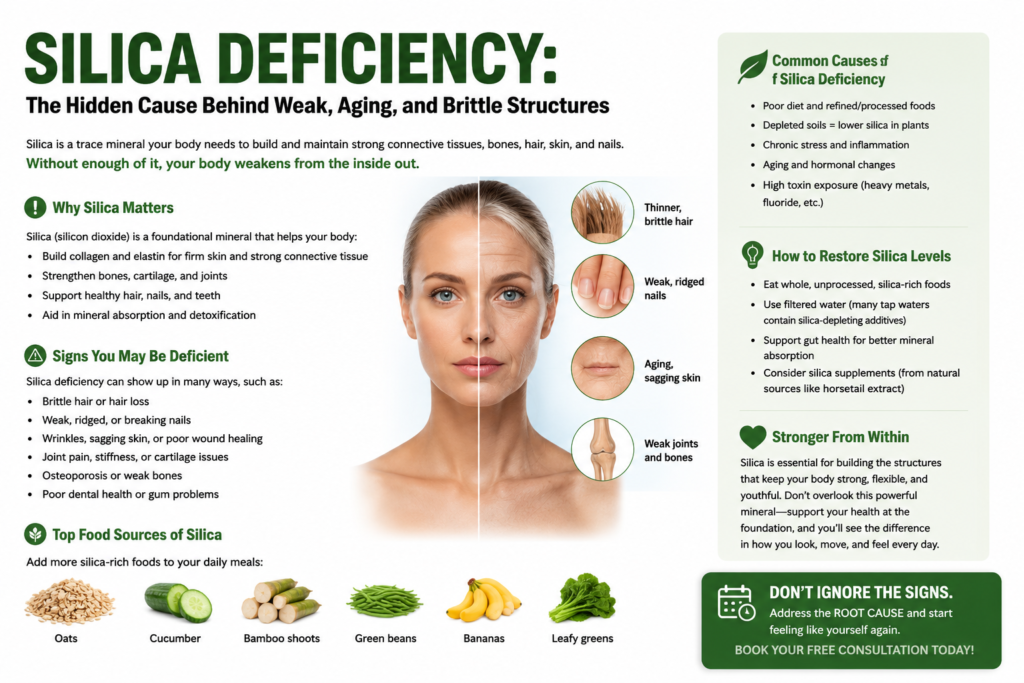
When people think about the minerals their body needs, calcium, magnesium, zinc, and iron usually come to mind. Silica rarely gets the same attention—yet silicon is present throughout the body and has been studied for its potential role in connective tissue and bone health. If your diet contains very little silicon-rich food, it may be worth looking at the bigger nutritional picture rather than focusing only on the nutrients everyone talks about.
What Is Silica?
Silica is a compound made from silicon and oxygen, while silicon is the element relevant to human nutrition. Dietary silicon occurs naturally in many plant foods and beverages, and researchers have investigated its involvement in collagen formation, connective tissue, and bone mineralization. Unlike well-established essential nutrients such as iron or vitamin C, however, silicon does not currently have an established Recommended Dietary Allowance (RDA), and a clearly defined human “silicon deficiency syndrome” has not been established.
That distinction matters—but it doesn’t mean silicon should simply be ignored. Your body depends on a complex network of nutrients, and focusing exclusively on the most famous vitamins and minerals can leave important nutritional gaps overlooked.
Why Does Silicon Matter?
Silicon has attracted particular interest because of its relationship with the body’s structural tissues. Research suggests it may be involved in bone formation and connective-tissue development, and observational research has found associations between higher dietary silicon intake and measures of bone health in some populations.
Think about your body as a structure: bones provide support, while collagen-rich connective tissues help hold everything together. Maintaining those tissues requires far more than calcium alone. Protein, vitamin C, magnesium, vitamin D, copper, zinc, and other nutrients all participate in the process—and silicon may be another piece of that nutritional puzzle.
This is why looking at nutrients individually can sometimes be misleading. You can consume plenty of one nutrient while still lacking others required for the same biological process.
Can You Actually Be Silica Deficient?
This is where many health articles overstate the science. There is currently no universally accepted clinical test or diagnostic criteria for “silica deficiency” in humans, and symptoms such as brittle nails, hair changes, joint discomfort, or poor bone health cannot automatically be blamed on low silicon.
Those symptoms can have many possible causes, including inadequate protein or micronutrient intake, hormonal changes, medical conditions, medications, aging, or other factors.
But that raises an important question: If you’re experiencing persistent symptoms, are you looking at your complete nutritional picture—or simply treating the symptom itself?
At Systemic Body, that’s the distinction we consider important. Rather than assuming one symptom equals one deficiency, the goal is to investigate the broader factors that may be contributing to what you’re experiencing.
Possible Signs That Your Nutrition Needs a Closer Look
Because a specific human silicon-deficiency syndrome hasn’t been established, there isn’t an official list of silica-deficiency symptoms. However, concerns involving bones, connective tissues, hair, skin, or nails may be good reasons to assess your overall nutritional status rather than immediately reaching for a silica supplement.
For example, recurring brittle nails could involve iron, zinc, protein, thyroid function, repeated chemical exposure, or other factors. Bone problems may involve vitamin D, calcium, magnesium, protein, hormones, physical activity, medications, and more.
The symptom is the clue—not necessarily the answer.
This is exactly why randomly buying supplements based on symptoms can become frustrating. You may spend months trying one nutrient after another without identifying what your body actually needs.
What Foods Naturally Contain Silicon?
Fortunately, silicon is naturally present in a variety of foods. Dietary sources can include whole grains such as oats and barley, green beans, certain vegetables, bananas, and other plant-based foods. The amount can vary considerably depending on the food, processing, and growing conditions.
Highly refined eating patterns may also provide a different micronutrient profile than diets built around varied whole foods. Instead of obsessing over one “superfood,” aim for dietary diversity.
Your body doesn’t run on silica alone—it runs on the interaction of many nutrients.
Should You Take a Silica Supplement?
Not necessarily.
Seeing a list of possible benefits and immediately buying the highest-dose silica supplement is exactly what we don’t recommend. More isn’t automatically better, and a symptom that appears nutritional may have nothing to do with silicon.
Before adding supplements, consider the more important questions: What does your current diet provide? What other nutrients could be inadequate? Are there competing explanations for your symptoms? And does supplementation actually make sense for you?
A personalized approach is much more useful than guessing.
Why Nutrition Is Often More Complicated Than “Take This Mineral”
One of the biggest mistakes in nutrition is treating every nutrient as though it works independently. It doesn’t.
Collagen production, for example, depends on adequate protein and vitamin C and involves multiple micronutrients. Bone health involves calcium, vitamin D, magnesium, protein, hormones, physical activity, and other factors. Even when silicon contributes to a process, correcting one nutrient while ignoring everything around it may not address the underlying problem.
That’s why someone can eat a seemingly healthy diet—or already take several supplements—and still feel that something isn’t right.
The better question isn’t simply: “Do I need more silica?”
It’s: “What does my body actually need, and what could be preventing me from getting the results I’m looking for?”
Stop Guessing and Start Looking at the Bigger Picture
If you’ve been dealing with persistent symptoms and continually trying new foods, vitamins, minerals, or supplements without getting the results you expected, another random supplement may not be the answer.
At Systemic Body, our approach is to look beyond a single symptom and examine potential contributing factors—including nutrition, toxicity, alignment, infections, emotions, and mind—to build a more individualized strategy.
Your symptoms may involve nutrition. They may involve something else. Or several factors may be interacting at the same time.
That’s exactly why identifying the bigger picture matters.
Ready to Find Out What Your Body May Be Missing?
Don’t spend another few months guessing which vitamin, mineral, or supplement you should try next.
Book your free consultation with Systemic Body and start taking a more personalized look at the factors that could be standing between you and feeling your best.
Healthfully,
Systemic Body
Note: I write every post; all this info comes from 10 years of daily testing for my own body.