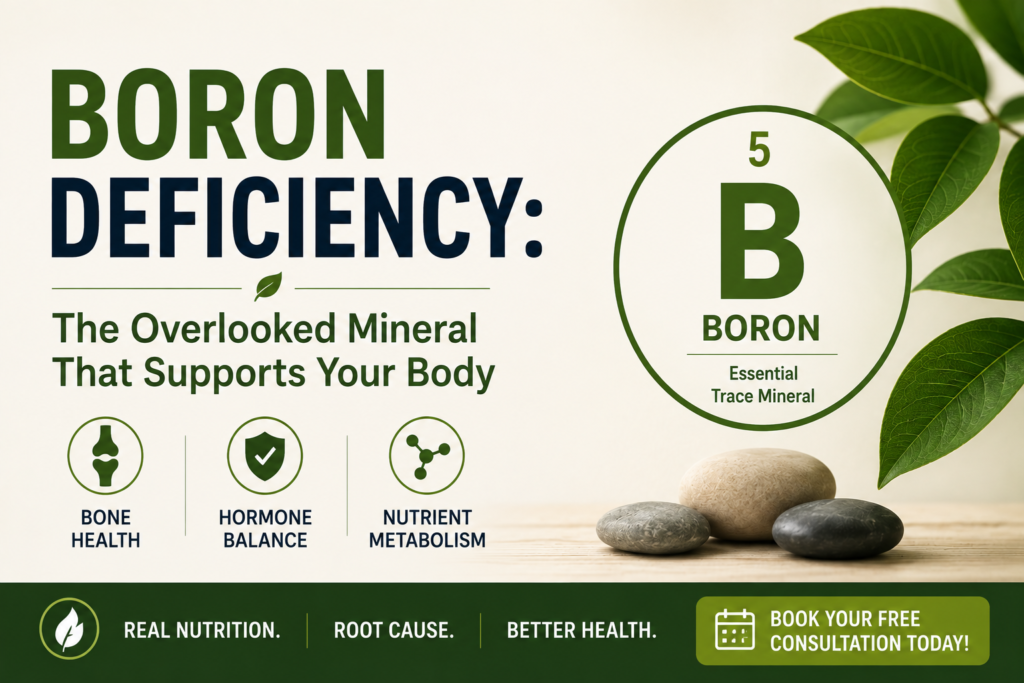
Boron doesn’t get nearly as much attention as magnesium, calcium, iron, or zinc, but this trace element has become increasingly interesting in nutrition research because it may influence bone and mineral metabolism, vitamin D, hormones, and other biological processes.
There is one important difference, however: boron is not currently classified as an essential nutrient for humans, and there is no established clinical condition called “boron deficiency” with a standard diagnostic cutoff.
That doesn’t mean boron has no role in the body. Research suggests that low boron intake can influence certain biological markers, particularly those related to bone and mineral metabolism.
So instead of simply asking, “Am I boron deficient?”, a better question may be: “Am I getting enough boron as part of an overall nutrient-rich diet, and are there other nutritional imbalances affecting my bones, minerals, or overall health?”
What Does Boron Do In The Body?
Boron appears to interact with several nutritional and metabolic systems rather than performing one isolated function.
Research has particularly explored its relationship with calcium, magnesium, vitamin D, bone metabolism, and steroid hormones.
Boron, Calcium & Magnesium
Calcium and magnesium are two of the body’s major minerals, and boron may influence how the body handles them.
This makes boron particularly interesting when looking at bone and mineral metabolism.
But it would be misleading to think of boron as a replacement for calcium or magnesium.
Instead, think of these nutrients as part of a larger system:
Calcium provides important structural material for bones. Magnesium participates in bone formation and hundreds of enzymatic reactions.
Vitamin D helps regulate calcium absorption and metabolism. Boron may influence aspects of how these nutrients are metabolized.
This is exactly why we prefer looking at nutritional balance as a whole rather than focusing on one isolated nutrient.
Boron & Bone Health
Most of the boron in the human body is found in bone, teeth, and other tissues, and much of the interest surrounding boron nutrition involves skeletal health.
Studies suggest that boron intake may influence markers involved in bone metabolism, particularly through interactions with other nutrients and hormones.
Healthy bones depend on much more than calcium alone. They require an appropriate combination of:
- Calcium
- Magnesium
- Vitamin D
- Phosphorus
- Protein
- Vitamin K
- Hormonal regulation
- Physical activity
Boron may be another piece of that larger nutritional picture.
So if you’re concerned about bone health, simply taking calcium while ignoring everything else may be missing the bigger picture.
Boron & Vitamin D
One particularly interesting area of boron research involves vitamin D metabolism.
Some studies have suggested that boron intake may influence vitamin D status or metabolism, although research is still developing, and boron should not be considered a treatment for vitamin D deficiency.
This relationship is important because vitamin D itself influences:
- Calcium absorption
- Bone mineralization
- Muscle function
- Immune function
- Numerous cellular processes
If someone has persistent vitamin D or mineral imbalances, it can therefore make sense to look at their overall nutritional status rather than repeatedly addressing one nutrient at a time.
Boron & Hormones
Boron has also been investigated for potential effects on steroid hormone metabolism, including estrogen and testosterone.
Some small studies have found changes in hormone concentrations following different levels of boron intake, but the evidence isn’t strong enough to claim that boron supplements reliably increase testosterone or balance hormones.
This is important because boron supplements are sometimes marketed using aggressive claims about testosterone.
Boron participates in biology, but that doesn’t make it a hormone-boosting miracle supplement.
Hormonal health depends on many factors, including nutrition, sleep, energy intake, body composition, age, medications, and underlying medical conditions.
What Happens When You Don’t Get Enough Boron?
Unlike iron deficiency anemia or iodine deficiency, there isn’t a well-established disease in humans caused specifically by inadequate boron intake.
There is also no recognized list of symptoms that can reliably diagnose low boron.
Research involving low-boron diets has suggested potential changes involving bone and mineral metabolism, particularly when other nutrients such as vitamin D or magnesium are also inadequate.
But symptoms such as:
- Fatigue
- Weak bones
- Joint discomfort
- Muscle problems
- Hormonal changes
- Poor concentration
should not automatically be attributed to boron.
All of these can have many different causes.
This is where nutritional investigation becomes much more useful than symptom guessing.
Why Might Your Boron Intake Be Low?
Boron occurs naturally in many plant foods, so intake depends heavily on the foods you regularly eat.
A Diet Low In Plant Foods
Some of the richest dietary sources of boron are fruits, vegetables, legumes, nuts, and certain dried fruits.
Someone eating very few plant foods may consequently consume less boron.
Highly Restrictive Diets
Extremely restrictive eating patterns can reduce intake of numerous micronutrients and trace elements.
In this situation, boron probably isn’t the only nutrient worth considering.
The better question becomes: “What else might be missing?”
Poor Overall Nutrition
A diet dominated by highly refined foods can provide fewer naturally occurring micronutrients than a varied whole-food diet.
Again, this is why focusing exclusively on boron can miss the larger nutritional picture.
What Foods Contain Boron?
One of the easiest ways to obtain boron is simply to eat a varied diet containing plenty of whole plant foods.
Fruits
Useful dietary sources can include:
- Avocados
- Apples
- Pears
- Grapes
- Peaches
- Oranges
Dried Fruits
Certain dried fruits can contain relatively concentrated amounts, including:
- Raisins
- Prunes
- Dried apricots
Nuts & Legumes
Sources can include:
- Peanuts
- Almonds
- Walnuts
- Beans
- Lentils
Vegetables
Various vegetables contribute smaller amounts of boron and can collectively contribute to overall intake.
The boron content of plant foods can vary depending partly on soil conditions and growing environment.
The objective doesn’t need to be finding one perfect “boron superfood.”
A varied whole-food diet naturally provides boron alongside many other nutrients.
Should You Take A Boron Supplement?
Not necessarily.
Because there is no established Recommended Dietary Allowance (RDA) for boron, supplementing boron isn’t as straightforward as correcting a well-established deficiency of an essential nutrient.
If your diet already contains fruits, vegetables, nuts, legumes, and other whole foods, you may already be consuming meaningful amounts of boron.
And as with other nutrients, more isn’t automatically better.
Very high boron intake can be harmful and may cause symptoms such as nausea, vomiting, diarrhea, headaches, or other adverse effects.
Rather than immediately purchasing another supplement, first ask: “Do I actually have a reason to believe boron is something I need to focus on?”
Boron Shows Why Nutrients Shouldn’t Be Treated Individually
Consider what happens when someone is concerned about their bones.
They may immediately buy calcium.
But healthy bone metabolism involves calcium + magnesium + vitamin D + vitamin K + protein + phosphorus + hormones + physical activity, with boron potentially interacting with parts of this system as well.
Or perhaps someone has repeatedly low vitamin D.
They keep increasing vitamin D supplementation without asking whether their magnesium status, absorption, diet, lifestyle, or other factors also deserve attention.
The body isn’t a collection of independent nutrients.
It’s a system.
And that’s exactly why our approach goes beyond simply matching one symptom to one supplement.
How Do You Know If Boron May Need Attention?
This is where boron is particularly different from something like iron.
There isn’t a routine clinical blood test used to diagnose a standard “boron deficiency,” and there isn’t an accepted symptom checklist that can tell you whether you need more boron.
So instead of guessing, we believe it’s more useful to look at your broader nutritional picture.
Energetic Testing
At Systemic Body, we use energetic testing as part of our personalized approach to exploring potential nutritional imbalances and identifying nutrients that may warrant further attention.
Depending on the individual, we can explore areas involving:
- Boron
- Calcium
- Magnesium
- Vitamin D
- Zinc
- Copper
- Other vitamins and minerals
- Amino acids
- Other nutritional factors
Instead of looking at one symptom and immediately recommending another supplement, we want to understand how the different pieces may connect.
For example, are there several nutrients showing potential imbalances? Is your diet providing what you need? Could digestion or absorption be involved? Are lifestyle, toxicity, or other systemic factors worth investigating?
Our goal is to give you a more individualized starting point instead of leaving you to endlessly guess which supplement to try next.
You Don’t Need Another Random Supplement—You Need A Better Starting Point
If you’ve been dealing with fatigue, joint or bone concerns, muscle problems, or other persistent symptoms, it’s easy to fall into the same cycle:
Read about a symptom → find a nutrient associated with it → buy the supplement → hope it works.
Then, when it doesn’t solve the problem, move on to the next supplement.
There is a better question to ask: “What does MY body actually need?”
At Systemic Body, our approach is designed to explore potential nutritional imbalances and look deeper into the factors that may be contributing to them.
Rather than focusing exclusively on boron—or calcium, magnesium, vitamin D, or any other single nutrient—we look at the bigger picture.
Stop guessing which nutrients you need. Start investigating why you don’t feel your best.
Healthfully,
Systemic Body
Note: I write every post; all this info comes from 10 years of daily testing for my own body.