When most people think about essential minerals, they think about magnesium, calcium, iron, or zinc.
Manganese rarely gets the same attention, but your body still needs small amounts of it for several important processes.
From metabolism and antioxidant defenses to bone formation, manganese works quietly behind the scenes, which is exactly why inadequate nutrition can sometimes be overlooked when you’re trying to understand why you don’t feel your best.
What Is Manganese?
Manganese is an essential trace mineral, meaning your body needs it in relatively small amounts but cannot simply function without it. It acts as a component or activator of several enzymes involved in metabolism, bone formation, antioxidant defenses, and other biological processes.
Because only small amounts are required and manganese is found in many foods, true dietary manganese deficiency appears to be uncommon in humans.
But uncommon doesn’t mean manganese is unimportant.
Your body doesn’t judge a nutrient by how famous it is—it needs the right nutrients available in the right amounts to perform its normal functions.
What Does Manganese Do in the Body?
One of manganese’s most interesting roles involves enzymes. Manganese helps activate enzymes your body uses to process carbohydrates, amino acids, and cholesterol, meaning it participates in the complex process of converting what you eat into compounds your body can actually use.
Manganese is also involved in bone formation and contributes to an important antioxidant enzyme called manganese superoxide dismutase (MnSOD), which helps protect cells against oxidative damage.
In other words, manganese isn’t just sitting inside your body doing nothing.
It’s participating in processes that happen every single day.
And that’s an important reminder: eating enough calories isn’t the same thing as giving your body every micronutrient it needs.
What Happens When You Don’t Get Enough Manganese?
Severe manganese deficiency in humans is considered rare, and our understanding of deficiency comes partly from limited experimental research.
Reported effects of very low manganese intake have included changes involving bone formation, metabolism, and skin, although symptoms are not specific enough to diagnose manganese deficiency simply based on how someone feels.
That’s extremely important.
If you’re experiencing fatigue, weakness, joint problems, changes in your hair or skin, or other persistent symptoms, you shouldn’t automatically assume manganese is responsible. Many nutritional deficiencies and medical conditions can produce overlapping symptoms.
The symptom tells you something deserves attention.
It doesn’t necessarily tell you the cause.
Could Your Diet Be Missing Important Trace Minerals?
This is where manganese becomes especially interesting.
Someone might pay close attention to protein, calories, calcium, vitamin D, or magnesium while barely thinking about trace minerals.
But your body doesn’t use nutrients independently.
A healthy metabolism depends on numerous vitamins, minerals, amino acids, enzymes, hormones, and other compounds working together. One missing piece can potentially affect processes that depend on multiple nutrients at the same time.
So instead of asking only: “Am I getting enough manganese?”
A better question may be: “Am I giving my body the complete nutritional foundation it needs?”
That is a much more useful place to start.
Signs You Should Take a Closer Look at Your Nutrition
Because manganese deficiency is rare and doesn’t have a simple set of unique symptoms, you cannot reliably identify it by looking at symptoms alone.
However, persistent problems involving energy, metabolism, bones, connective tissues, or general well-being can be reasons to examine your overall nutritional status and consider whether something is being overlooked.
And that’s where people often make a mistake.
They experience a symptom, search online, find a nutrient associated with that symptom, buy the supplement, take it for several weeks—and then move on to the next supplement when nothing changes.
Your body is more complicated than “one symptom = one nutrient.”
The real goal should be identifying what your body actually needs instead of continually guessing.
What Foods Are High in Manganese?
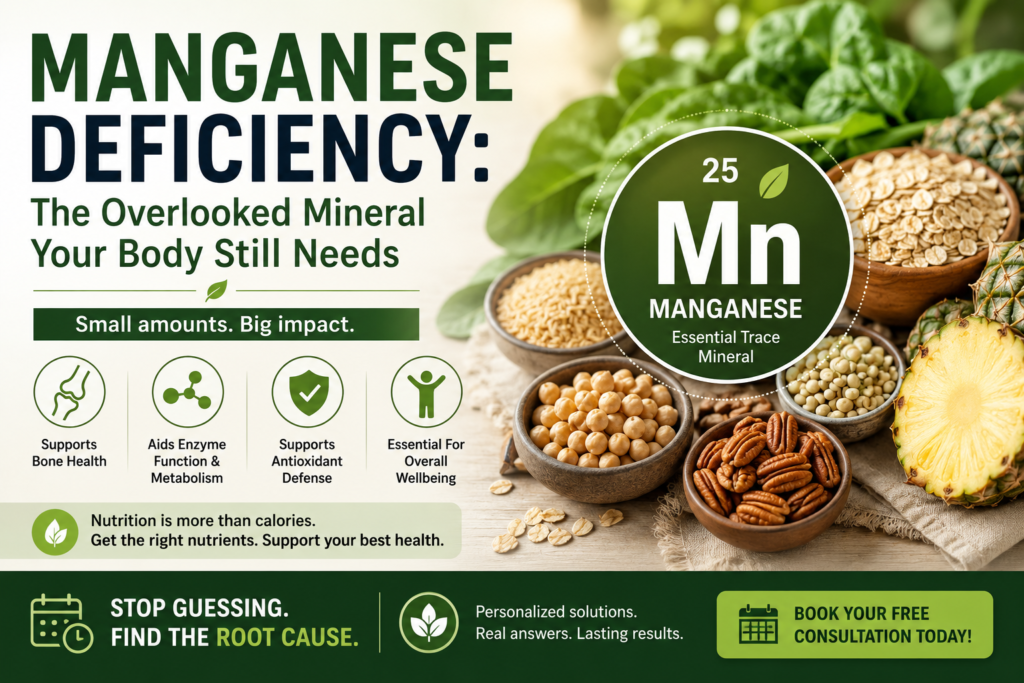
The good news is that manganese occurs naturally in many whole foods. Good dietary sources include whole grains, nuts, legumes, leafy vegetables, certain fruits, tea, and other plant foods.
Foods such as oats, brown rice, chickpeas, lentils, pecans, hazelnuts, spinach, and pineapple can contribute manganese to your diet.
A varied whole-food diet will generally provide manganese alongside many of the other nutrients your body requires.
And that’s one reason we prefer looking at nutrition as a complete system.
Food doesn’t contain one nutrient. Your body doesn’t need one nutrient. And your health usually can’t be reduced to one nutrient either.
Should You Take a Manganese Supplement?
Not automatically.
Manganese is essential—but too much manganese can also be harmful, particularly with excessive or prolonged exposure. High manganese accumulation can affect the nervous system, which is why taking large amounts simply because you suspect a deficiency isn’t a smart approach.
This is one area where “more” definitely doesn’t mean “better.”
Instead of immediately buying manganese supplements, first look at your diet, your overall nutrient intake, your symptoms, and any other factors that could explain what you’re experiencing.
Supplementation should have a reason behind it—not just a guess.
Why Taking More Supplements Isn’t Always the Answer
Imagine trying to build a house while you’re missing several different materials.
Delivering truckloads of one material won’t necessarily finish the house.
Nutrition can work similarly.
Your metabolism depends on manganese—but it also depends on magnesium, zinc, copper, iron, B vitamins, amino acids, and numerous other nutrients. Your bones require far more than calcium. Your antioxidant defenses rely on multiple nutrients and enzymes.
Correcting one nutrient while overlooking the rest of the system may leave the bigger problem untouched.
This is why some people accumulate a cabinet full of supplements yet still don’t understand why they aren’t getting the results they expected.
Stop Chasing Symptoms—Look for What They’re Telling You
If you’ve been dealing with persistent symptoms, it’s easy to fall into a frustrating cycle:
A symptom appears.
You search for the cause.
You find a supplement.
You try it.
Nothing really changes.
Then you start again.
But what if the problem isn’t that you haven’t found the right supplement yet? What if you haven’t identified the right underlying factors?
At Systemic Body, we take a broader approach by looking at potential contributing factors through our 6 Root Causes: Nutrition, Toxicity, Alignment, Infections, Emotions, and Mind.
The goal isn’t to assume manganese—or any single nutrient—is responsible for everything you’re experiencing.
The goal is to stop guessing and start looking at the bigger picture.
Are You Giving Your Body What It Actually Needs?
Your body relies on dozens of vitamins, minerals, amino acids, fatty acids, and other compounds working together every day. Manganese may only be required in tiny quantities, but small doesn’t mean insignificant.
If you’ve been trying different diets and supplements but still feel like something is missing, it may be time for a more individualized approach.
Find the Root Cause Instead of Trying Another Random Supplement
Don’t spend another few months guessing what your body needs.
At Systemic Body, we look beyond isolated symptoms to help identify potential nutritional and lifestyle factors that may deserve attention and build a more customized approach around you.
Healthfully,
Systemic Body
Note: I write every post; all this info comes from 10 years of daily testing for my own body.