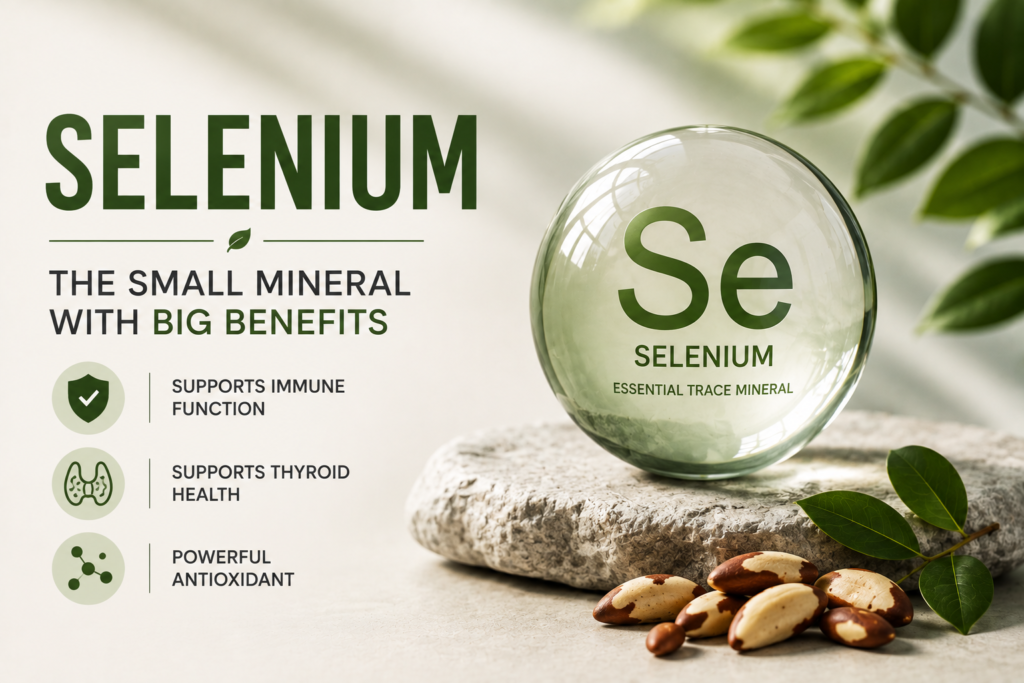
Selenium is a nutrient your body only needs in very small amounts.
But small doesn’t mean unimportant.
Selenium is an essential trace mineral incorporated into specialized proteins known as selenoproteins.
These proteins participate in several important processes throughout the body, including:
- Antioxidant defense
- Thyroid hormone metabolism
- DNA synthesis
- Reproduction
- Immune function
- Cellular protection
Selenium is particularly interesting because it connects two major areas of health:
Protecting your cells from oxidative damage and helping your thyroid hormones function properly.
But selenium also demonstrates an important nutritional principle:
Too little can be harmful—but too much can also become toxic.
The goal is balance.
Selenium’s Special Role In The Body
Unlike minerals required in relatively large quantities, selenium is considered a trace mineral.
The body incorporates selenium into specific proteins rather than simply using it as a free-standing mineral.
These selenoproteins perform specialized jobs throughout your tissues.
Two of the most important involve antioxidant protection and thyroid hormone metabolism.
Selenium & Your Antioxidant Defense System
Every day, normal metabolism produces reactive molecules commonly referred to as free radicals.
Your body has its own antioxidant defense systems designed to keep these molecules under control.
One important family of antioxidant enzymes is known as glutathione peroxidases.
Several glutathione peroxidase enzymes contain selenium.
These enzymes help reduce potentially damaging peroxides and protect cells from excessive oxidative stress.
This doesn’t mean selenium is some type of magical “detox supplement.”
Instead, selenium is one of the nutrients your body uses to build its own protective enzyme systems.
That distinction matters.
Your body already possesses sophisticated systems for managing oxidative stress. Your job nutritionally is to provide the raw materials that those systems require.
Selenium & Your Thyroid
Your thyroid contains a relatively high concentration of selenium compared with many other tissues.
Why? Because selenium-containing enzymes participate in both thyroid hormone metabolism and the protection of thyroid tissue.
Your thyroid produces primarily:
- T4 — Thyroxine
- T3 — Triiodothyronine
T3 is the more biologically active thyroid hormone.
Certain selenium-dependent enzymes called iodothyronine deiodinases help activate and deactivate thyroid hormones, including the conversion between T4 and T3.
So think of it this way:
Iodine helps build thyroid hormones.
Selenium helps regulate their activation and metabolism.
This is why thyroid nutrition isn’t about one nutrient. It’s a system.
Selenium Also Helps Protect The Thyroid
Producing thyroid hormones involves chemical reactions that generate hydrogen peroxide.
Hydrogen peroxide is useful in controlled amounts, but excessive accumulation can damage cells.
Selenium-dependent antioxidant enzymes help the thyroid manage this oxidative environment.
So selenium has a dual relationship with thyroid health:
It participates in thyroid hormone metabolism AND antioxidant protection.
What Happens When Selenium Is Too Low?
Mildly inadequate selenium intake may not produce obvious symptoms.
A more significant deficiency can interfere with normal selenoprotein function.
Possible effects can involve:
- Muscle function
- Thyroid hormone metabolism
- Immune function
- Reproductive health
- Antioxidant defenses
However, there’s an important point:
There Is No Simple “Selenium Deficiency Symptom List”
Fatigue doesn’t prove you’re selenium deficient.
Hair changes don’t prove you’re selenium deficient.
Thyroid symptoms don’t prove you’re selenium deficient.
Many nutritional and medical problems can produce overlapping symptoms.
The presence of symptoms should therefore lead to investigation, not automatic high-dose supplementation.
Severe Selenium Deficiency & Keshan Disease
One of the best-known conditions associated with severe selenium deficiency is Keshan disease.
Keshan disease is a type of cardiomyopathy historically observed in selenium-deficient regions, particularly parts of China.
Importantly, selenium deficiency appears to interact with other factors in the development of the disease rather than acting as the only explanation.
Severe selenium deficiency has also been associated with other health problems in populations where soil and dietary selenium are extremely low.
These conditions illustrate how important adequate selenium can be, even though the body only requires a small amount.
Why Would Someone Become Selenium Deficient?
For many people, eating a varied diet, selenium deficiency is uncommon.
However, several circumstances can increase the risk.
1. Where Your Food Comes From Matters
Here’s something unusual about selenium:
The selenium concentration of plant foods depends heavily on the soil in which they were grown.
Plants absorb selenium from soil.
If the soil contains very little selenium, foods grown there may also contain less.
This means two seemingly identical foods grown in different regions can contain different amounts of selenium.
The selenium content of animal foods can also be influenced by the selenium content of animal feed.
2. Very Restrictive Diets
People consuming highly restrictive diets may have difficulty obtaining adequate amounts of several nutrients, including selenium.
Dietary selenium can come from:
- Seafood
- Fish
- Meat
- Poultry
- Eggs
- Dairy
- Grains
- Legumes
- Nuts and seeds
Eating a varied diet reduces dependence on any single food source.
3. Digestive & Absorption Problems
Eating a nutrient doesn’t guarantee that your body will absorb it normally.
Certain gastrointestinal disorders or surgeries can interfere with nutrient absorption.
If someone develops several nutritional deficiencies simultaneously, it’s worth asking:
Is the problem really each individual nutrient?
Or: Is something interfering with digestion or absorption overall?
This is an important distinction.
4. Kidney Disease & Dialysis
People undergoing kidney dialysis can have altered selenium status due to dietary restrictions, illness, and losses associated with treatment.
These situations require individualized medical and nutritional management rather than simply adding supplements independently.
5. Long-Term Intravenous Nutrition
People who receive nutrition intravenously for prolonged periods can develop trace-element deficiencies if their nutritional formulation doesn’t contain adequate amounts.
Modern parenteral nutrition protocols generally account for essential trace elements, including selenium, but monitoring may still be required.
Which Foods Contain Selenium?
Selenium is naturally present in many foods.
You don’t necessarily need a selenium supplement to obtain meaningful amounts of this trace mineral.
Seafood
Good sources can include:
- Tuna
- Sardines
- Shrimp
- Salmon
- Halibut
Fish and seafood can provide meaningful amounts of selenium together with protein and other nutrients.
Meat & Poultry
Foods such as:
- Beef
- Turkey
- Chicken
- Pork
can also contribute selenium.
Eggs & Dairy
Eggs, milk, yogurt, and other dairy products can contribute selenium as part of an overall varied diet.
Grains & Legumes
Depending on where they were grown, grains and legumes can also contribute selenium.
What About Brazil Nuts?
Brazil nuts are probably the food most strongly associated with selenium.
And yes: Brazil nuts can contain extremely high amounts of selenium.
But their selenium content can vary substantially.
This means Brazil nuts shouldn’t necessarily be treated like an unlimited snack when someone is deliberately trying to increase selenium.
You don’t need huge quantities.
Because selenium has a relatively narrow range between adequate and excessive intake, consistently consuming large amounts of extremely selenium-rich foods can potentially push selenium intake unnecessarily high.
Selenium + Iodine: A Nutritional Partnership
The thyroid provides an excellent example of how nutrients work together.
Iodine
Iodine provides the raw material used to produce thyroid hormones.
Selenium
Selenium supports enzymes involved in thyroid hormone activation and metabolism.
Iron
Iron supports thyroid peroxidase, an enzyme involved in thyroid hormone synthesis.
Zinc
Zinc participates in numerous aspects of hormone metabolism and cellular signaling.
Protein
Protein provides amino acids, including tyrosine, which is incorporated into thyroid hormones.
The thyroid doesn’t need one miracle nutrient.
It needs an appropriately functioning nutritional system.
Should You Take Selenium For Your Thyroid?
This is where caution is important.
Because selenium is involved in thyroid physiology, selenium supplements are frequently marketed for “thyroid support.”
But: Supporting thyroid biology doesn’t mean everyone with thyroid symptoms needs additional selenium.
If someone already consumes adequate selenium, adding more isn’t automatically beneficial.
Research has examined selenium supplementation in autoimmune thyroid conditions such as Hashimoto’s thyroiditis, but this doesn’t mean high-dose selenium is appropriate for everyone with thyroid disease.
Supplementation decisions should consider:
- Dietary intake
- Overall nutritional status
- Thyroid condition
- Medications
- Other supplements
- Medical history
Can You Get Too Much Selenium?
Yes.
And this is extremely important.
Chronically consuming excessive selenium can cause selenosis, or selenium toxicity.
Possible signs of excessive selenium intake can include:
- Hair loss
- Brittle nails
- Nausea
- Diarrhea
- Fatigue
- Skin changes
- Neurological symptoms
- A characteristic garlic-like odor on the breath
Ironically, some symptoms people might interpret as signs that they “need more selenium” can actually occur when selenium intake is excessive.
That’s why blindly increasing the dose based on symptoms is a bad strategy.
More Isn’t Better—The Right Amount Is Better
Selenium perfectly demonstrates the difference between nutritional optimization and nutritional excess.
Too little selenium can impair normal biological functions.
But excessive selenium can become toxic.
The goal isn’t: “Get as much selenium as possible.”
It’s: “Get enough selenium to meet your body’s requirements without chronically exceeding them.”
For many people, a varied whole-food diet can accomplish exactly that.
How Do You Know If Your Selenium Is Low?
Assessing selenium deficiency can be done with energetic testing. Book an appointment with us below, and we will tell you all about your deficiencies, not just selenium.
Start With Food, Then Look At The Bigger Picture
If you’re concerned about selenium, start by looking at your overall diet.
Are you regularly consuming a variety of:
- Fish and seafood
- Meat or poultry
- Eggs
- Dairy
- Legumes
- Grains
- Nuts and seeds?
Then ask the bigger questions.
Are you consuming enough protein and micronutrients overall?
Is your digestive system absorbing nutrients normally?
Are multiple deficiencies occurring together?
Are you already taking supplements containing selenium?
Is there an underlying thyroid or medical condition causing your symptoms?
At Systemic Body, we focus on understanding how nutrients interact rather than simply matching every symptom with another supplement.
Selenium doesn’t work alone. It interacts with iodine, proteins, enzymes, antioxidants, and the thyroid system to help maintain normal physiology.
The objective is to determine what your body actually needs, what may be interfering with normal function, and where the underlying imbalance originates.
Healthfully,
Systemic Body
Note: I write every post; all this info comes from 10 years of daily testing for my own body.