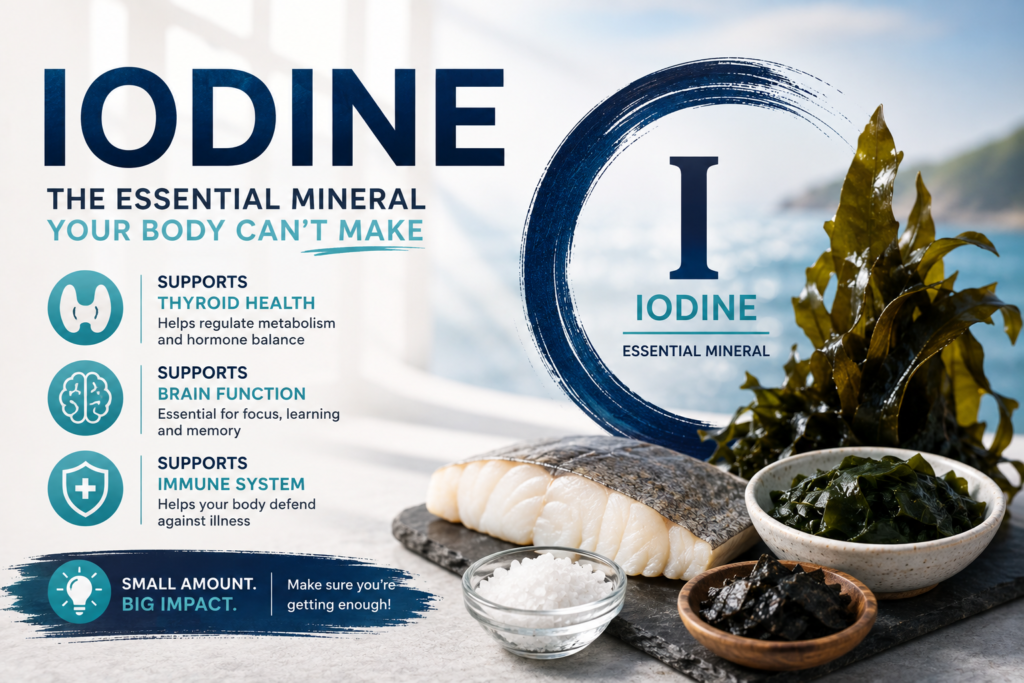
A tiny amount of iodine can have an enormous impact on the human body.
Unlike calcium, which is stored extensively in bones, or potassium, which is distributed throughout cells, iodine has one particularly important relationship:
Your thyroid needs iodine to manufacture thyroid hormones.
These hormones influence metabolic activity throughout the body.
When iodine intake remains inadequate, the thyroid may no longer have enough raw material to produce thyroid hormones normally. The body responds by trying to stimulate the thyroid harder.
Over time, this can contribute to thyroid enlargement (goiter) and, in some people, hypothyroidism.
So understanding iodine deficiency starts with understanding the thyroid.
Iodine → Thyroid → Your Entire Body
Your thyroid is a small, butterfly-shaped gland located at the front of your neck.
Despite its size, the hormones it produces influence many tissues throughout your body.
Two major thyroid hormones are:
T4 — Thyroxine
T4 contains four iodine atoms.
T3 — Triiodothyronine
T3 contains three iodine atoms and is the more biologically active thyroid hormone.
The connection is right in their names.
Iodine is literally part of the structure of thyroid hormones.
Without adequate iodine, normal thyroid hormone production can become more difficult.
What Do Thyroid Hormones Actually Control?
People often hear that the thyroid controls “metabolism,” but that term can sound vague.
Thyroid hormones influence how quickly many of your cells perform their normal activities.
That means iodine can indirectly affect many systems through its role in thyroid hormone production.
Energy & Metabolism
Thyroid hormones help regulate metabolic rate and energy use.
When thyroid hormone production becomes inadequate, people may experience symptoms such as:
- Fatigue
- Low energy
- Feeling sluggish
- Reduced exercise tolerance
But fatigue alone doesn’t mean you have an iodine deficiency.
Many nutritional, hormonal, medical, sleep-related, and lifestyle factors can produce similar symptoms.
Body Temperature
Thyroid hormones influence heat production and energy expenditure.
People with hypothyroidism may become unusually sensitive to cold.
Again, feeling cold doesn’t prove iodine deficiency.
The thyroid problem needs to be properly evaluated.
Brain & Nervous System
Thyroid hormones are particularly important during pregnancy, infancy, and childhood, when the brain and nervous system are developing.
This is one reason adequate iodine intake during pregnancy is so important.
Severe iodine deficiency during fetal and early childhood development can cause permanent neurological and developmental impairment.
Growth & Development
Thyroid hormones also participate in normal physical growth and development.
Children with significant untreated iodine deficiency and resulting hypothyroidism can experience impaired growth and development.
Iodine, therefore, becomes especially important during periods when nutritional requirements are higher.
What Happens When You Don’t Get Enough Iodine?
The thyroid has a sophisticated feedback system.
When thyroid hormone production falls, the brain and pituitary gland can increase signals telling the thyroid to work harder.
One of the most important signals is:
TSH — Thyroid-Stimulating Hormone
TSH tells the thyroid to produce thyroid hormones.
If iodine intake is inadequate, the thyroid may receive stronger stimulation while still lacking enough iodine to manufacture hormones normally.
Over time, this stimulation can cause the thyroid to enlarge.
The result is known as a:
Goiter
A goiter simply means an enlarged thyroid gland.
Iodine deficiency is one important cause of goiter worldwide, although thyroid enlargement can have several other causes.
A visible or noticeable swelling in the neck should therefore be properly evaluated rather than assumed to be caused by iodine deficiency.
Signs That Can Occur With Iodine Deficiency
Many symptoms associated with iodine deficiency actually result from its effects on thyroid function.
Possible symptoms can include:
Fatigue & Low Energy
Reduced thyroid hormone production can contribute to fatigue and sluggishness.
Feeling Cold
People with hypothyroidism may become more sensitive to cold temperatures.
Weight Changes
An underactive thyroid can reduce energy expenditure and contribute to weight gain in some people.
Weight changes, however, are influenced by many different factors.
Dry Skin
Hypothyroidism can contribute to dry or coarse skin.
Hair Changes
Hair may become dry, coarse, or thin when thyroid function is significantly impaired.
Constipation
Thyroid hormones influence gastrointestinal motility, so hypothyroidism can contribute to slower bowel movements.
Difficulty Concentrating
Some people with hypothyroidism describe slower thinking, memory problems, or difficulty concentrating.
Neck Swelling
An enlarged thyroid can sometimes create visible swelling at the front of the neck.
None of these symptoms individually diagnose iodine deficiency.
Why Would Someone Become Iodine Deficient?
Unlike several of the electrolyte deficiencies we’ve discussed, iodine deficiency is often closely connected to dietary intake.
But several factors can influence risk.
1. Not Using Iodized Salt
Salt itself doesn’t naturally contain reliable amounts of iodine.
Iodized salt has iodine deliberately added to it.
The introduction of iodized salt dramatically reduced iodine deficiency in many countries.
However, not every type of salt is necessarily iodized.
Products marketed as:
- Sea salt
- Himalayan salt
- Kosher salt
- Specialty salts
may contain little iodine unless the label specifically says they are iodized.
Someone can therefore consume plenty of salt while still consuming relatively little iodine.
2. Eating Few Iodine-Rich Foods
Natural iodine concentrations vary considerably between foods.
Some useful dietary sources include:
- Seaweed
- Cod
- Tuna
- Shrimp
- Other seafood
- Milk
- Yogurt
- Eggs
- Iodized salt
The amount of iodine in foods can vary depending on where and how they were produced.
Seaweed can contain especially high amounts—but this creates another issue we’ll discuss shortly.
3. Vegan Or Highly Restrictive Diets
People avoiding:
- Seafood
- Dairy
- Eggs
- Iodized salt
may have fewer reliable sources of iodine in their diet.
A vegan diet can absolutely be nutritionally adequate, but iodine is one nutrient that deserves deliberate attention because many common iodine sources are animal-derived.
4. Pregnancy
Iodine requirements increase during pregnancy.
The mother’s thyroid hormone production increases, iodine losses through the kidneys can increase, and iodine is needed to support fetal development.
Adequate iodine is particularly important because thyroid hormones are essential for normal fetal brain development.
Pregnant or breastfeeding individuals should discuss iodine requirements and supplementation with an appropriate healthcare professional rather than guessing at the dose.
5. Certain Foods & Goitrogens
You may have heard that foods such as broccoli, cabbage, cauliflower, kale, or soy “damage the thyroid.”
That’s an oversimplification.
Some foods contain compounds that can interfere with iodine utilization under certain circumstances.
These are sometimes called goitrogens.
For most people consuming adequate iodine and a varied diet, normal consumption of cruciferous vegetables is generally not a reason to avoid these highly nutritious foods.
The issue becomes more relevant when iodine intake is already inadequate, and large quantities of certain goitrogenic foods are consumed.
The answer isn’t: “Stop eating broccoli.”
It’s: “Make sure your overall nutrition is adequate.”
More Iodine Is NOT Always Better
This is probably the most important section of this article.
Once someone learns that iodine is necessary for the thyroid, it’s easy to think:
If some iodine is good, more iodine must be better.
That’s incorrect.
Excessive iodine can also disturb thyroid function.
Very high iodine intake can trigger thyroid dysfunction in susceptible individuals, including either hypothyroidism or hyperthyroidism.
This is especially relevant with certain seaweed products and high-dose iodine supplements.
Some seaweeds can contain extremely concentrated and highly variable amounts of iodine.
So while seaweed can be an excellent iodine source, more isn’t automatically better.
Your thyroid needs the right amount, not the maximum amount.
Iodine Doesn’t Work Alone
Another common mistake is thinking:
Thyroid = iodine. The thyroid system is far more complex.
Several nutrients participate in normal thyroid physiology.
Iodine
Provides the raw material used to construct T3 and T4.
Selenium
Selenium-dependent enzymes help activate and deactivate thyroid hormones and protect thyroid tissue from oxidative stress.
Iron
Iron is required for the normal activity of thyroid peroxidase, an enzyme involved in thyroid hormone production.
Zinc
Zinc participates in numerous aspects of hormone metabolism and cellular signaling.
Protein & Amino Acids
Thyroid hormones aren’t built from iodine alone. Their structure also involves the amino acid tyrosine.
Once again: Nutrients work as a system.
How Do You Know If You’re Iodine Deficient?
Symptoms aren’t enough. Book an appointment below, and we will test you. An iodine deficiency is very common, from our experiences. A lot of patients have a deficiency.
How Do You Correct Inadequate Iodine Intake?
If dietary iodine is inadequate, the goal is to establish a reliable and appropriate source of iodine.
That might include:
Iodized Salt
Check the package. It should specifically say iodized.
You don’t need enormous amounts of salt to obtain iodine, and increasing salt intake excessively isn’t the objective.
Seafood
Fish and shellfish can contribute meaningful iodine.
Dairy & Eggs
These foods can also contribute iodine, depending on how they are produced.
Seaweed
Seaweed can contain large amounts of iodine, but concentrations vary dramatically between species and products.
Because some varieties contain extremely high levels, seaweed shouldn’t automatically be consumed in unlimited quantities.
What About Iodine Supplements?
Iodine supplementation can be appropriate in certain situations, including when dietary intake is inadequate or during life stages with increased requirements.
But blindly taking high-dose iodine is not the same thing as correcting a deficiency safely.
This is especially important if someone already has:
- Hashimoto’s thyroiditis
- Graves’ disease
- Thyroid nodules
- Hyperthyroidism
- Hypothyroidism
- Other thyroid disorders
Anyone with an established thyroid condition should be particularly cautious about changing iodine intake dramatically without appropriate medical guidance.
The Thyroid Needs Balance, Not Megadoses
Iodine demonstrates one of the most important principles in nutrition:
Deficiency can cause problems.
But: Excess can cause problems, too.
The goal isn’t to consume as much iodine as possible.
It’s to provide the thyroid with the nutrients it requires while understanding the broader system influencing thyroid function.
If you’re experiencing fatigue, cold intolerance, constipation, unexplained weight changes, hair changes, or swelling around the thyroid, don’t automatically assume iodine is the answer.
Ask:
Is my thyroid actually functioning abnormally?
Am I getting enough iodine?
Am I getting too much iodine?
Are other nutrients involved?
Is there an underlying thyroid condition?
At Systemic Body, we focus on understanding these relationships rather than simply matching every symptom with another supplement.
The goal is to determine what your body needs and identify the nutritional and systemic factors contributing to the imbalance.
Healthfully,
Systemic Body
Note: I write every post; all this info comes from 10 years of daily testing for my own body.