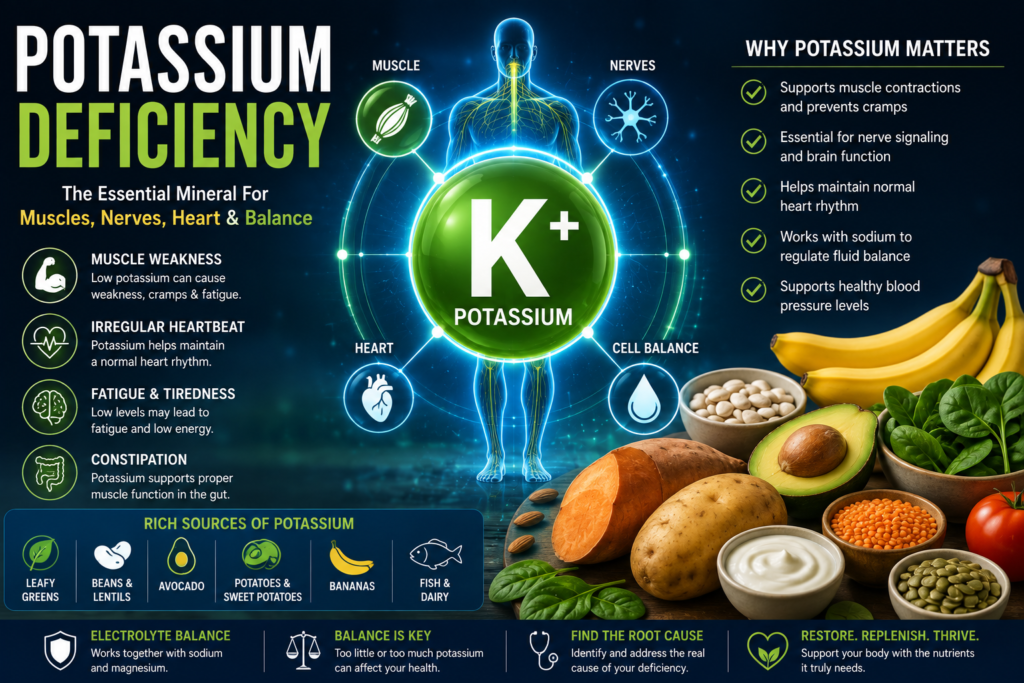
Potassium is one of the body’s most important electrolytes.
Every day, your nerves, muscles, heart, and cells depend on potassium to function normally. It works closely with sodium, magnesium, and other minerals to maintain the electrical and fluid balance that keeps your body working properly.
When potassium levels in the blood become too low, the condition is known as hypokalemia.
But here’s the important part:
Low potassium doesn’t always mean you’re simply not eating enough potassium.
In many cases, potassium is lost through the digestive tract or kidneys. Certain medications and health conditions can also cause potassium levels to fall.
So instead of immediately asking: “How can I get more potassium?”
A better question is:
“Why is my potassium low in the first place?”
What Does Potassium Actually Do?
Potassium is found primarily inside your cells, where it helps maintain the electrical gradients required for normal cellular function.
Although only a relatively small amount circulates in the bloodstream, keeping blood potassium within the appropriate range is extremely important.
Your Heart
Your heart relies on carefully controlled electrical signals to maintain a normal rhythm.
Potassium plays an essential role in these electrical processes. When potassium becomes significantly too low or too high, abnormal heart rhythms can occur.
Your Muscles
Muscle contraction depends on the movement of electrolytes across cell membranes.
Without adequate potassium, muscles may not contract normally.
This can contribute to:
- Muscle weakness
- Muscle cramps
- Twitching
- Fatigue
A severe deficiency can cause much more significant muscle dysfunction.
Your Nervous System
Your nerves communicate using electrical impulses.
Potassium helps establish the electrical conditions necessary for those impulses to occur.
This is why significant electrolyte disturbances can affect both muscle and neurological function.
Your Fluid & Electrolyte Balance
Potassium works closely with sodium.
While sodium is found primarily outside cells, potassium is concentrated primarily inside cells.
Together, these electrolytes help regulate:
- Fluid distribution
- Nerve signaling
- Muscle contraction
- Cellular function
- Blood pressure regulation
Your body isn’t trying to maximize one mineral. It’s trying to maintain balance.
What Does Potassium Deficiency Feel Like?
Mild hypokalemia may cause few or no noticeable symptoms.
As potassium falls further, symptoms can become more apparent.
Possible symptoms include:
Muscle Weakness
Weakness is one of the more recognizable symptoms of significant potassium deficiency.
Your muscles require potassium for normal electrical activity and contraction.
Muscle Cramps & Twitching
Electrolyte disturbances can interfere with normal muscle activity, potentially causing cramps, spasms, or twitching.
Fatigue
Low potassium can interfere with normal muscle and cellular function and may contribute to fatigue or reduced physical performance.
Constipation
The digestive tract contains smooth muscle that helps move food through the intestines.
Significant potassium deficiency can interfere with normal intestinal muscle function and contribute to constipation.
Heart Palpitations
Because potassium plays such an important role in the heart’s electrical system, significant hypokalemia can cause abnormal heart rhythms.
This can sometimes feel like:
- Fluttering
- Skipped beats
- Racing
- Irregular heartbeats
Heart palpitations should not automatically be assumed to be caused by potassium deficiency because they have many possible causes.
Why Would Your Potassium Become Low?
This is where understanding potassium deficiency becomes more interesting.
Simply eating too little potassium is only one possible explanation.
1. Vomiting & Diarrhea
Your digestive system can lose substantial amounts of fluid and electrolytes during prolonged vomiting or diarrhea.
These losses can include:
- Potassium
- Sodium
- Chloride
- Water
If the losses continue long enough, blood potassium can fall. This is why maintaining both hydration and electrolyte balance can become important during significant gastrointestinal illness.
2. Certain Diuretics
Some medications increase urine production and can cause the kidneys to eliminate more potassium.
Certain diuretics used for conditions such as high blood pressure or fluid retention are a common cause of hypokalemia.
This doesn’t mean someone should stop their medication.
Instead, potassium levels may need to be monitored and treatment adjusted by the prescribing healthcare professional when appropriate.
3. Excessive Potassium Loss Through The Kidneys
Your kidneys continually regulate how much potassium stays in your body and how much leaves through urine.
Certain kidney-related or hormonal conditions can cause the body to eliminate excessive potassium.
In these cases, eating potassium-rich foods may help nutritional intake, but doesn’t necessarily correct the underlying reason potassium keeps being lost.
4. Magnesium Deficiency
Potassium and magnesium are closely connected.
Significant magnesium deficiency can make low potassium more difficult to correct because magnesium influences how the kidneys handle potassium.
In some cases of persistent hypokalemia, healthcare professionals therefore evaluate magnesium levels as well.
This is a good example of why nutrients shouldn’t always be considered individually. The body functions as an interconnected system. That’s why we created Systemic Body.
5. Hormonal Problems
Hormones help determine how much sodium and potassium the kidneys retain or eliminate.
One particularly important hormone is aldosterone.
Excessive aldosterone activity can cause the kidneys to retain sodium while eliminating more potassium.
Certain adrenal and hormonal disorders can therefore contribute to persistent low potassium.
6. Certain Medications
Diuretics aren’t the only medications that can influence potassium.
Other medications can alter potassium through effects on:
- Kidney function
- Hormones
- Gastrointestinal losses
- Movement of potassium between the blood and cells
If potassium repeatedly becomes low, reviewing medications with a healthcare professional can be an important part of finding the cause.
7. Not Eating Enough Potassium-Rich Foods
Diet can still matter.
Many whole foods naturally contain potassium, while highly processed dietary patterns may provide less potassium.
Some excellent potassium-rich foods include:
- Potatoes
- Sweet potatoes
- Avocados
- Beans
- Lentils
- Spinach
- Tomatoes
- Bananas
- Oranges
- Yogurt
- Salmon
And despite their reputation, bananas aren’t necessarily the richest potassium food available.
Potatoes, legumes, leafy vegetables, avocados, and several other foods can provide substantial amounts.
Potassium Doesn’t Work Alone
One of the biggest mistakes when thinking about nutrition is looking at every nutrient independently.
Your body doesn’t work that way. Potassium interacts with:
Sodium — to help regulate fluid distribution, electrical signaling, and blood pressure.
Magnesium — which influences potassium balance and normal cellular function.
Calcium — which participates in muscle contraction and electrical signaling.
Water — which affects the concentration and distribution of electrolytes throughout the body.
This is why simply taking increasingly larger amounts of one electrolyte isn’t always the best solution.
The goal is a proper balance.
How Do You Correct Potassium Deficiency?
The answer depends on why potassium is low and how severe the deficiency is.
If inadequate dietary intake is contributing, increasing potassium-rich whole foods can be a useful starting point.
Consider foods such as:
Potatoes & Sweet Potatoes
Excellent whole-food sources of potassium that also provide carbohydrates and other micronutrients.
Avocados
Provide potassium together with healthy fats and other nutrients.
Beans & Lentils
Excellent sources of potassium, magnesium, fiber, and plant protein.
Leafy Greens
Spinach and other leafy vegetables contribute potassium along with numerous vitamins and minerals.
Fruits
Bananas, oranges, cantaloupe, apricots, and several other fruits provide potassium.
Fish & Dairy
Salmon, yogurt, milk, and certain other animal foods can also contribute meaningful amounts.
A varied whole-food diet generally makes more sense than relying on one supposedly “high-potassium” food.
What About Potassium Supplements?
Potassium supplementation requires more caution than many people realize.
Both too little and too much potassium can be dangerous.
Excessively high potassium—known as hyperkalemia—can interfere with the electrical activity of the heart and cause dangerous heart rhythms.
The risk can be especially important in people with:
- Kidney disease
- Certain heart conditions
- Adrenal disorders
- Certain medications that increase potassium
For this reason, high-dose potassium supplementation should not be used casually without understanding your potassium status and overall health.
When significant hypokalemia is confirmed, the appropriate replacement strategy depends on its severity and cause.
When Is Low Potassium Dangerous?
Severe hypokalemia can become medically serious.
Seek prompt medical evaluation for symptoms such as:
- Significant muscle weakness
- Paralysis
- Fainting
- Severe heart palpitations
- Abnormal heart rhythm
- Severe or persistent vomiting or diarrhea
People taking medications known to affect potassium may also require periodic blood testing.
Book an appointment with us below, and we will tell you if you have a potassium deficiency.
Stop Chasing The Nutrient—Find The Cause
If your potassium is low, taking potassium may replace what you’ve lost.
But it doesn’t necessarily explain why you lost it.
Maybe your diet isn’t providing enough.
Maybe you’re losing electrolytes through vomiting or diarrhea.
Maybe a medication is increasing potassium loss.
Maybe magnesium is also low.
Maybe your kidneys or hormones are causing excessive potassium excretion.
These situations require completely different approaches.
That’s why correcting nutritional imbalances should involve more than simply matching a symptom to a supplement.
At Systemic Body, we focus on identifying the nutritional and systemic factors contributing to the imbalance so that you can understand what your body actually needs and why.
Healthfully,
Systemic Body
Note: I write every post; all this info comes from 10 years of daily testing for my own body.