When people struggle with energy, cravings, blood sugar fluctuations, or difficulty managing their weight, they often immediately blame calories, carbohydrates, or willpower. But your metabolism depends on much more than what you eat—it also depends on whether your body has the nutrients required to properly process what you eat. One trace mineral that deserves attention is chromium.
What Is Chromium?
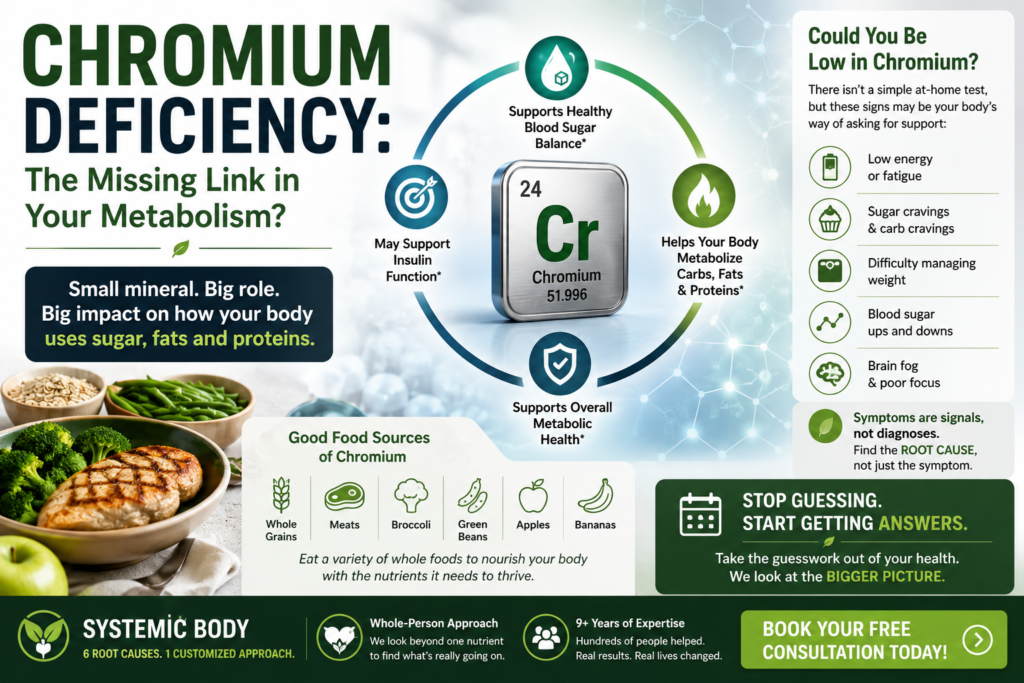
Chromium is a trace mineral found naturally in certain foods. The form relevant to nutrition is trivalent chromium (chromium III), which has been studied primarily for its relationship with insulin and the metabolism of carbohydrates, fats, and proteins.
Your body only needs very small amounts—but that’s exactly why trace minerals are so easy to overlook.
Small requirement doesn’t mean unimportant.
If you’re focused exclusively on calories, protein, carbohydrates, and fat while ignoring micronutrients, you may be missing an important part of the nutritional picture.
Why Is Chromium Important?
One of chromium’s best-known areas of research involves insulin, the hormone that helps regulate glucose in your bloodstream and allows cells to use glucose for energy.
Chromium has been proposed to support insulin action, although researchers are still investigating exactly how significant its role is in humans.
This distinction matters because chromium is sometimes marketed online as though it’s a miracle solution for blood sugar or weight loss.
It isn’t.
Your metabolism depends on an enormous network of nutrients, hormones, enzymes, organs, sleep, physical activity, and lifestyle factors working together.
Chromium may be one piece of that system—but understanding the entire system is far more important than chasing one nutrient. That’s why I created Systemic Body ©.
What Happens With Chromium Deficiency?
True chromium deficiency appears to be very rare in generally healthy people, and much of what medicine knows about severe deficiency comes from unusual situations such as patients receiving long-term intravenous nutrition without adequate chromium.
In documented cases, inadequate chromium has been associated with impaired glucose tolerance and abnormalities in glucose metabolism, which improved after chromium was provided.
But this doesn’t mean that experiencing sugar cravings, fatigue after eating, stubborn weight gain, or blood sugar problems proves that you’re chromium deficient.
Those symptoms can have many different causes.
And that’s exactly where people often go wrong.
They identify the symptom—and assume they’ve identified the cause.
Are Your Symptoms Really Telling You to Take More Chromium?
Imagine you’re constantly craving sweets.
You search online.
You read that chromium is involved in glucose metabolism.
You buy chromium supplements.
But what if chromium was never the primary issue?
Your symptoms could potentially involve your overall diet, protein intake, sleep, stress, activity levels, medications, hormones, another nutrient—or a medical condition requiring appropriate evaluation.
This is why treating symptoms by guessing supplements can become an endless cycle.
You try chromium.
Then magnesium.
Then another supplement.
Then another diet.
Months later, you’re still searching.
Instead of asking “Which supplement treats this symptom?”, sometimes the better question is:
“WHY is my body producing this symptom in the first place?”
Possible Signs Your Metabolic Health Deserves Attention
However, if you’re regularly experiencing problems such as unusual changes in energy, persistent cravings, unexplained changes in weight, or concerns about blood sugar, those are reasons to look more carefully at your overall health rather than simply ignoring them.
And if you have symptoms of abnormal blood sugar, proper medical testing is important.
Remember: Symptoms are signals. They aren’t diagnoses.
Finding the right explanation is what matters.
What Foods Naturally Contain Chromium?
Chromium is present in a variety of foods, although the amount can vary considerably depending on agricultural and manufacturing processes.
Dietary sources can include whole grains, meats, certain fruits and vegetables, and other minimally processed foods.
Broccoli, whole-grain products, meat, apples, bananas, and green beans may provide some chromium, for example.
But there’s another important lesson here:
You don’t eat nutrients—you eat food.
A whole-food diet gives your body chromium alongside magnesium, potassium, B vitamins, amino acids, antioxidants, fiber, and many other compounds your metabolism uses.
That’s why improving nutritional quality is usually much more powerful than obsessing over one isolated mineral.
Should You Take Chromium Supplements?
This is where marketing can become misleading.
Chromium supplements—particularly chromium picolinate—are frequently promoted for blood sugar control, reducing cravings, improving metabolism, and weight loss.
But the research doesn’t support treating chromium as a magic metabolic solution, and supplementation isn’t automatically necessary simply because you’re experiencing metabolic symptoms.
Taking more of something your body doesn’t need isn’t the same as correcting a deficiency.
The goal isn’t MORE nutrients. The goal is the RIGHT nutrients, in the RIGHT amounts, for the RIGHT person.
That’s a completely different approach. That’s what I teach people coming to me for treatment.
Your Metabolism Is a System—Not a Single Nutrient
Here’s what often gets missed.
Your body needs nutrients to process nutrients.
The carbohydrates you eat don’t magically turn themselves into usable cellular energy. Vitamins, minerals, enzymes, hormones, and numerous biochemical pathways participate in that process.
Chromium is only one piece.
Magnesium matters.
B vitamins matter.
Protein matters.
Other trace minerals matter.
Sleep matters.
Movement matters.
Hormonal health matters.
And your overall diet matters.
So if you’re struggling with your metabolism, focusing on chromium alone may be like trying to repair an entire engine by replacing one bolt.
You have to look at the system…
Stop Chasing Symptoms. Start Looking for the Root Cause.
At Systemic Body, we don’t believe every health problem can be explained by chromium—or by any single vitamin, mineral, food, or supplement.
That’s why we look at health through our 6 Root Causes: Nutrition, Toxicity, Alignment, Infections, Emotions, and Mind.
Nutrition may be part of your problem.
Chromium may or may not be relevant.
Another nutrient could deserve attention.
Or multiple factors could be interacting at the same time.
The important part is that you stop guessing.
Because when you’ve been dealing with the same symptoms for months or years, continually trying another supplement isn’t much of a strategy.
What Is Your Body Actually Asking For?
Your symptoms may be frustrating—but they can also be the reason to investigate your health more carefully.
If you’ve already tried changing your diet, taking supplements, eliminating foods, exercising more, or following advice you found online and you’re still not getting the results you want, it may be time to approach the problem differently.
Don’t just ask: “What can I take for this?”
Start asking: “What could be contributing to this—and what does MY body actually need?”
That’s where a personalized approach begins.
Ready to Stop Guessing?
You don’t need another cabinet full of supplements you aren’t sure you need.
You need a clearer understanding of the factors that may be affecting you.
At Systemic Body, our goal is to look beyond isolated symptoms and help you build a more personalized approach based on the bigger picture.
You’ve spent enough time searching for answers. Now it’s time to start looking for the ROOT CAUSE.
Healthfully,
Systemic Body
Note: I write every post; all this info comes from 10 years of daily testing for my own body.