Feeling exhausted even after getting enough sleep?
Getting winded more easily than you used to?
Feeling weak, cold, dizzy, or unable to concentrate?
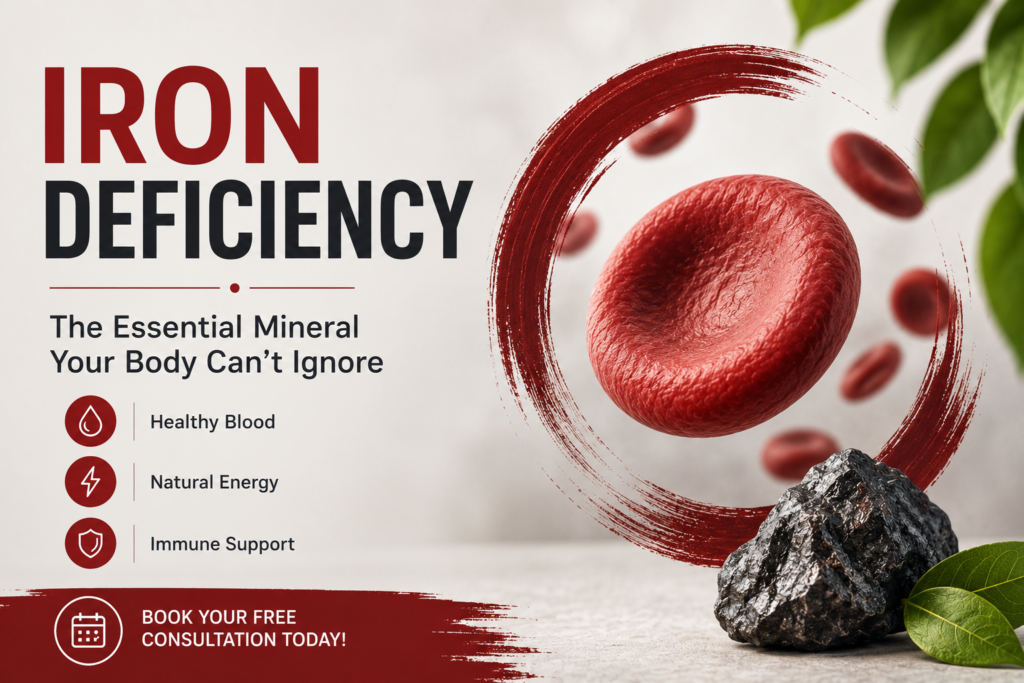
Iron deficiency is one possible explanation—and it is one of the most common nutritional deficiencies worldwide.
But here’s what many people miss:
Finding out that your iron is low is only half of the answer.
The next question is: WHY is it low?
You can eat more iron-rich foods or take an iron supplement, but if you’re losing iron, not absorbing it properly, or another nutritional imbalance is interfering with normal red blood cell production, simply adding more iron may not address the underlying problem.
At Systemic Body, this is exactly what we want to investigate.
We don’t want you endlessly guessing which vitamin or mineral you need.
We want to help you understand what your body may be missing and why.
What Does Iron Actually Do?
Iron is an essential mineral with one particularly important job:
Helping your body transport oxygen.
Iron is a central component of hemoglobin, the protein inside red blood cells that carries oxygen from your lungs to tissues throughout your body.
Your muscles also contain an iron-containing protein called myoglobin, which helps store and use oxygen.
Iron additionally participates in:
- Cellular energy production
- Enzyme function
- DNA synthesis
- Normal immune function
- Brain and neurological function
When your body doesn’t have enough iron available, these processes can eventually be affected.
Iron & Your Energy
Every cell in your body needs energy.
And oxygen is essential for efficient energy production.
When iron deficiency progresses far enough to reduce healthy red blood cell production and hemoglobin, less oxygen can be transported effectively throughout the body.
This can contribute to:
- Persistent fatigue
- Weakness
- Reduced endurance
- Shortness of breath with activity
- Difficulty exercising
- Feeling physically drained
If you’ve been blaming yourself for “not having enough energy,” it may be worth investigating whether your body is actually receiving the nutrients it needs to function normally.
Iron & Your Brain
Your brain also depends on iron.
Iron participates in normal neurological function and neurotransmitter metabolism.
Iron deficiency can sometimes be associated with:
- Difficulty concentrating
- Reduced mental performance
- Fatigue
- Irritability
People sometimes describe these experiences simply as “brain fog.”
But brain fog isn’t a diagnosis. The goal is to determine what may be contributing to it.
What Are The Signs Of Iron Deficiency?
Iron deficiency can develop gradually.
Initially, the body’s iron stores may decline without producing obvious symptoms.
As the deficiency becomes more significant—and particularly if iron-deficiency anemia develops—symptoms may become more noticeable.
Possible signs can include:
- Persistent fatigue
- Weakness
- Pale skin
- Dizziness
- Headaches
- Shortness of breath
- Heart palpitations
- Difficulty concentrating
- Feeling unusually cold
- Reduced exercise tolerance
- Restless legs
- Brittle nails
- Hair loss
Some people can also develop pica, an unusual craving for non-food substances such as ice, clay, or dirt.
But there’s something extremely important to understand:
These symptoms don’t automatically mean you’re iron-deficient.
Fatigue could involve B12, folate, thyroid function, magnesium, sleep, stress, inadequate calories, illness, or many other factors.
Hair loss can have completely different causes.
Shortness of breath can have causes unrelated to nutrition and may require prompt medical assessment.
That’s exactly why guessing based on symptoms can send you in the wrong direction.
The Question Isn’t Just “Is My Iron Low?”
Imagine discovering that your car keeps running out of oil.
You could continuously add more oil.
But wouldn’t you eventually want to know:
Where is the oil going?
Iron can be similar.
If your body repeatedly becomes iron-deficient, continually replacing iron without investigating the reason may leave an important question unanswered.
Why is your iron becoming low?
There are several possibilities.
Why Does Iron Deficiency Happen?
1. You’re Not Eating Enough Iron
Dietary intake is one possibility.
Iron exists in food in two major forms:
Heme iron comes primarily from animal foods and is generally absorbed more efficiently.
Sources include:
- Beef
- Liver and organ meats
- Lamb
- Poultry
- Fish
- Shellfish
Non-heme iron occurs in plant foods such as:
- Lentils
- Beans
- Chickpeas
- Tofu
- Spinach
- Pumpkin seeds
- Fortified foods
Both can contribute to iron intake, but their absorption differs.
This means the amount of iron listed in a food isn’t necessarily the same as the amount your body ultimately absorbs.
2. You’re Losing Iron
This is a major reason iron deficiency shouldn’t simply be treated as a food problem.
Blood contains iron.
Therefore: Blood loss = iron loss.
Heavy menstrual bleeding is a common cause of iron deficiency.
Blood loss can also occur from the gastrointestinal tract.
Potential causes include ulcers, gastrointestinal inflammation, certain medications, hemorrhoids, polyps, cancers, and other conditions.
This is particularly important for men and postmenopausal women with unexplained iron deficiency, where gastrointestinal blood loss may need to be investigated medically.
Simply taking iron shouldn’t replace finding the source of unexplained blood loss.
3. You’re Eating Iron—But Not Absorbing Enough
You can eat a nutrient without necessarily absorbing all of it.
Iron absorption occurs primarily in the upper small intestine and is influenced by several dietary and physiological factors.
Certain gastrointestinal conditions can interfere with normal absorption.
Examples include:
- Celiac disease
- Crohn’s disease
- Certain stomach or intestinal surgeries
- Other malabsorption disorders
If you repeatedly struggle with nutritional deficiencies despite eating a nutrient-dense diet, it can be worth looking beyond food intake.
The issue may involve digestion and absorption.
4. Your Requirements Have Increased
There are periods when the body requires more iron.
Pregnancy is one important example.
Iron requirements increase substantially because iron is needed to support expanded maternal blood volume and fetal development.
Children and adolescents also require adequate iron during periods of rapid growth.
This is why the same diet may meet someone’s needs at one stage of life but become inadequate when requirements increase.
Iron Doesn’t Work Alone
This is one of the biggest reasons we don’t like looking at nutrients in isolation.
Healthy red blood cell production requires more than iron.
Vitamin B12
Vitamin B12 is necessary for normal DNA synthesis and red blood cell development.
Folate
Folate is also essential for normal red blood cell production.
Copper
Copper helps your body properly transport and utilize iron.
Significant copper deficiency can actually contribute to anemia.
Vitamin A
Vitamin A participates in normal iron metabolism and red blood cell production.
Protein
Your body needs amino acids to manufacture the proteins that make up blood and tissues.
This is why simply hearing:
“I’m tired, so I need iron.”
can be misleading.
Your body is an interconnected system.
And sometimes the symptom you’re trying to solve has multiple nutritional contributors.
Vitamin C Can Help You Absorb Iron
Vitamin C can improve the absorption of non-heme iron, the form found primarily in plant foods.
For example, combining:
- Lentils with peppers
- Beans with tomatoes
- Leafy greens with citrus
- Iron-containing meals with vitamin C-rich vegetables
can help improve non-heme iron absorption.
But other dietary components can reduce iron absorption when consumed at the same time.
These can include certain phytates and polyphenols.
Again, nutrition isn’t simply about how much of a nutrient is in your food.
It’s also about what your body can absorb and utilize.
Should You Just Take An Iron Supplement?
This is where many people make a mistake.
They feel tired.
They read that fatigue can be caused by low iron.
They buy iron.
But iron is not a supplement you should take indiscriminately.
Too much iron can be harmful.
Iron supplements can also cause side effects such as:
- Constipation
- Nausea
- Abdominal discomfort
- Dark stools
More importantly, if your iron is actually low, you still want to understand:
Why?
Is your diet inadequate?
Are you losing blood?
Is your digestive system absorbing iron properly?
Are other nutrients involved?
Is there an underlying medical condition?
Taking a supplement may replace iron.
It doesn’t automatically answer any of those questions.
How Do You Know If Your Iron Is Low?
This is where we encourage you to stop guessing.
If you’ve been struggling with unexplained fatigue, weakness, poor concentration, reduced exercise tolerance, hair changes, or other persistent symptoms, your body may be telling you that something deserves attention.
But symptoms alone cannot tell you exactly what that something is.
Energetic Testing At Systemic Body
At Systemic Body, we use energetic testing as part of our personalized approach to exploring potential nutritional imbalances.
Rather than assuming: Fatigue = iron
or Hair loss = iron
We look at the broader nutritional picture.
Our energetic testing can be used to explore nutrients that may warrant further attention, including:
- Iron
- Vitamin B12
- Folate
- Copper
- Zinc
- Magnesium
- Vitamins
- Amino acids
- Other nutritional factors
This allows us to look beyond one isolated nutrient and explore patterns of potential nutritional imbalance.
We can then ask more useful questions:
What nutrients may need attention?
Could several deficiencies be contributing to your symptoms?
Are you consuming what your body needs?
Could digestion or absorption be interfering?
Are lifestyle, nutrition, toxicity, or other systemic factors involved?
But our approach can help you stop randomly choosing supplements and start looking at your nutritional picture in a more individualized way.
You don’t have to keep guessing what your body needs.
Stop Treating Your Symptoms Like Separate Problems
Maybe you’re exhausted.
Maybe your hair is thinning.
Maybe you’re getting headaches.
Maybe you feel weak.
Maybe your workouts suddenly feel much harder.
Maybe you’ve already purchased multiple supplements, hoping one of them will finally make you feel normal again.
But what if those symptoms aren’t separate problems?
What if they’re clues pointing toward a nutritional or systemic imbalance that hasn’t been properly investigated?
That’s the philosophy behind our approach at Systemic Body.
We don’t want to simply ask: “What supplement treats fatigue?”
We want to ask: “Why are YOU fatigued?”
And: “What does YOUR body actually need?”
Your nutrition, digestion, absorption, lifestyle, environmental exposures, and other factors can all influence how you feel.
Instead of continuing to guess, start investigating.
Ready To Find Out What Your Body May Be Missing?
If you’ve been dealing with persistent symptoms and don’t know where to start, we’ll help you look at the bigger picture.
Our personalized approach is designed to identify potential nutritional imbalances and investigate the factors that may be contributing to them.
Stop guessing And Book Your Spot Below.
Healthfully,
Systemic Body
Note: I write every post; all this info comes from 10 years of daily testing for my own body.