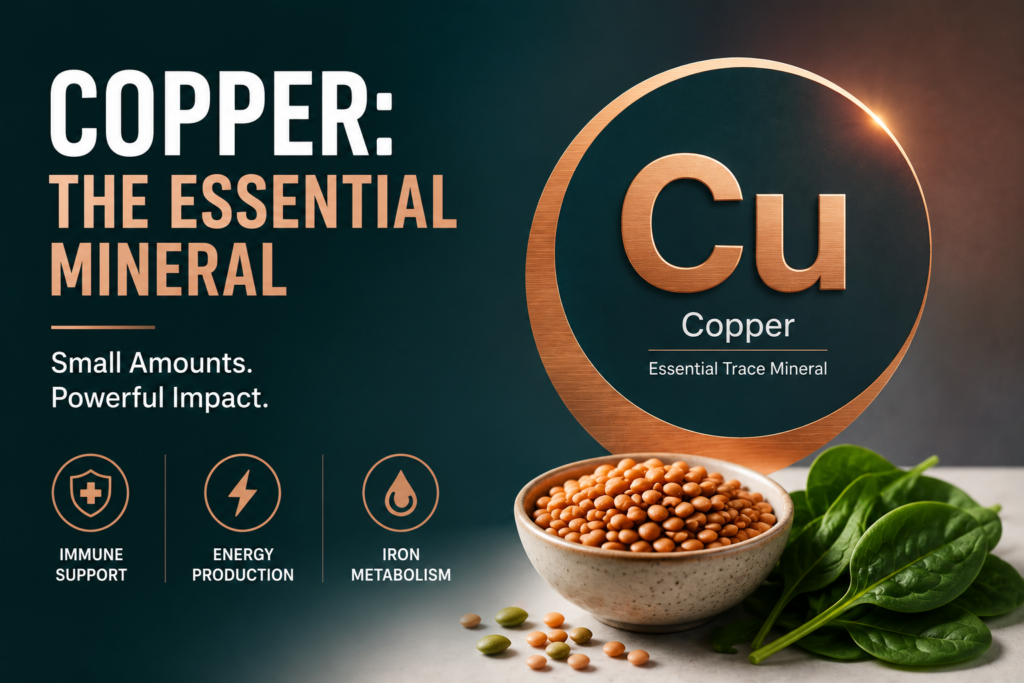
Copper is needed in tiny amounts, but it participates in some surprisingly important processes throughout the body.
It helps your body use iron, produce energy, maintain connective tissue, support the nervous system, form pigment, and protect cells from oxidative damage.
Copper is therefore much more than another mineral on a nutrition label.
Your body needs copper-dependent enzymes to perform specific chemical reactions that other nutrients cannot simply replace.
But copper also has an important relationship with another trace mineral: Zinc.
Too little copper can cause problems, but consuming excessive amounts of zinc for long periods can also interfere with copper absorption and potentially create a deficiency.
Understanding copper, therefore, isn’t just about asking: “Am I eating enough copper?”
You also need to consider absorption, zinc intake, digestive health, and why your copper might be low in the first place.
What Does Copper Actually Do In Your Body?
Copper acts primarily as a component of enzymes known as cuproenzymes.
These enzymes participate in several biological systems.
Copper Helps Your Body Use Iron
One of copper’s most important relationships is with iron metabolism.
Your body may contain iron, but that iron still needs to be transported and utilized appropriately.
Copper-dependent proteins help move iron through the body and make it available for processes such as red blood cell production.
This creates an important nutritional connection:
Low copper can interfere with normal iron metabolism.
As a result, significant copper deficiency can contribute to anemia.
This means that anemia isn’t always simply an iron problem.
If someone repeatedly struggles with anemia despite apparently adequate iron, the broader nutritional and medical picture may need to be considered.
Copper Supports Red Blood Cell Formation
Because copper helps regulate iron metabolism, it indirectly supports the production of healthy red blood cells.
Red blood cells carry oxygen from your lungs to tissues throughout the body.
When significant copper deficiency contributes to anemia, symptoms can potentially include:
- Fatigue
- Weakness
- Reduced exercise tolerance
- Pale skin
- Shortness of breath
However, these symptoms have many possible causes and cannot be used to diagnose copper deficiency on their own.
Copper Supports Energy Production
Inside your cells are structures called mitochondria. Their job is to convert nutrients into usable cellular energy.
A copper-containing enzyme called cytochrome c oxidase plays an essential role in the mitochondrial electron transport chain.
In simpler terms, Copper helps your cells participate in normal energy production.
This is another reason significant copper deficiency may be associated with fatigue and weakness.
But fatigue alone doesn’t mean you need copper. The underlying cause still needs to be identified.
Copper & Your Nervous System
Copper is important for normal neurological function.
Severe or prolonged copper deficiency can affect the spinal cord and peripheral nerves.
Possible neurological manifestations can include:
- Numbness
- Tingling
- Weakness
- Difficulty walking
- Balance problems
In some cases, neurological copper deficiency can resemble problems associated with vitamin B12 deficiency.
This is particularly important because prolonged neurological damage may not always completely reverse after the deficiency is corrected.
New or progressive neurological symptoms should therefore receive proper medical evaluation rather than being treated through supplements alone.
Copper Helps Build Connective Tissue
Your body is held together by an enormous network of connective tissue.
This includes structures involving:
- Collagen
- Elastin
- Blood vessels
- Skin
- Bone
- Cartilage
Copper is required for an enzyme called lysyl oxidase.
This enzyme helps create cross-links between collagen and elastin fibers, contributing to the strength and stability of connective tissues.
So while nutrients such as vitamin C are commonly associated with collagen, copper also participates in maintaining normal connective tissue.
Once again: No nutrient works alone.
Copper & Antioxidant Protection
Copper also participates in your body’s antioxidant defense systems.
One important enzyme is copper-zinc superoxide dismutase (Cu/Zn SOD).
This antioxidant enzyme contains both Copper + Zinc
and helps protect cells from certain reactive oxygen species.
This is a great example of how two minerals that can compete during absorption can also work together once they’re inside the body.
Nutrition is about balance and relationships, not simply maximizing individual nutrients.
Copper & Skin, Hair And Pigmentation
Copper is required for tyrosinase, an enzyme involved in producing melanin.
Melanin contributes to pigmentation in:
- Skin
- Hair
- Eyes
Severe copper deficiency can therefore sometimes affect pigmentation.
Copper also participates indirectly in maintaining skin and connective tissue through its role in collagen and elastin formation.
However, changes in hair color, hair loss, or skin appearance should not automatically be interpreted as copper deficiency.
Many other nutritional, hormonal, genetic, and medical factors can cause similar changes.
What Can Copper Deficiency Look Like?
True copper deficiency is relatively uncommon in people consuming a varied diet with normal absorption.
When a significant deficiency occurs, possible manifestations can include:
- Anemia
- Fatigue
- Weakness
- Low white blood cell counts
- Increased susceptibility to infection
- Numbness or tingling
- Difficulty walking
- Balance problems
- Bone abnormalities
- Changes in pigmentation
But there is no single symptom that tells you: “You are copper-deficient.”
Why Would Your Copper Become Low?
Sometimes dietary intake is responsible.
But copper deficiency can also develop even when copper-containing foods are being consumed.
1. Excessive Zinc Intake
This is one of the most important causes to understand.
High amounts of zinc can interfere with copper absorption in the intestine.
Zinc stimulates the production of a protein called metallothionein inside intestinal cells.
Metallothionein binds copper particularly strongly.
The copper can then become trapped within intestinal cells instead of entering circulation and is eventually lost when those cells are shed.
The practical takeaway is simple:
Taking high-dose zinc for long periods can potentially create copper deficiency.
This is why zinc and copper should not be considered independently.
2. Digestive & Absorption Problems
Copper is absorbed through the gastrointestinal tract.
Conditions that significantly impair nutrient absorption can therefore increase the risk of deficiency.
These may include:
- Celiac disease
- Certain gastrointestinal surgeries
- Chronic malabsorption disorders
- Other significant digestive conditions
If several nutrients are repeatedly low at the same time, the question shouldn’t always be:
“Which supplements am I missing?”
It may be: “Why isn’t my digestive system absorbing nutrients properly?”
3. Bariatric & Gastrointestinal Surgery
Certain surgeries that alter the stomach or small intestine can reduce the absorption of copper and other nutrients.
Copper deficiency can sometimes develop years after bariatric surgery.
Because neurological symptoms from copper deficiency can become significant, long-term nutritional monitoring can be particularly important after procedures that substantially alter nutrient absorption.
4. Inadequate Dietary Intake
Copper occurs naturally in many foods, so severe deficiency from diet alone is uncommon.
However, extremely restrictive diets or severe malnutrition can contribute.
If overall food intake is inadequate, copper is also unlikely to be the only nutrient affected.
5. Rare Genetic Conditions
Certain rare inherited disorders can interfere with copper transport and metabolism.
One example is Menkes disease, which severely disrupts normal copper distribution in the body.
These conditions are fundamentally different from ordinary dietary copper deficiency and require specialized medical care.
Which Foods Are High In Copper?
Copper is found in a wide variety of foods.
Organ Meats
Liver is one of the richest natural sources of copper.
Because organ meats can contain extremely high concentrations of certain nutrients, enormous quantities aren’t necessary.
Shellfish
Oysters and other shellfish can provide substantial amounts of copper.
Dark Chocolate
Cocoa and dark chocolate can contribute meaningful amounts of copper, along with magnesium and other minerals.
Nuts & Seeds
Good plant sources include:
- Cashews
- Sunflower seeds
- Sesame seeds
- Almonds
Legumes
Foods such as:
- Lentils
- Chickpeas
- Beans
can contribute copper while also providing protein, fiber, and other minerals.
Other Sources
Copper can also be obtained from:
- Mushrooms
- Whole grains
- Potatoes
- Certain seafood
A varied whole-food diet generally provides copper without requiring someone to depend on a single “superfood.”
The Zinc–Copper Balance
If there’s one concept to remember from this article, it’s this:
Zinc and copper affect each other.
Your body needs both.
Zinc supports immune function, DNA synthesis, wound healing, and many other processes.
Copper supports iron metabolism, connective tissue, neurological function, pigmentation, and antioxidant enzymes.
But chronically consuming excessive zinc can reduce copper absorption.
This means someone taking high-dose zinc because they believe it supports their immune system could potentially create a completely different nutritional imbalance.
The objective isn’t: More zinc.
Or: More copper.
It’s: The appropriate amount of both.
Should You Take A Copper Supplement?
Not automatically.
If true copper deficiency has been identified, copper replacement may be appropriate depending on the cause and severity.
But taking copper without knowing whether you actually need it isn’t necessarily beneficial.
Too much copper can also be harmful.
Copper supplementation deserves particular caution when someone has a disorder affecting copper metabolism.
For example, Wilson’s disease causes abnormal accumulation of copper in the body and requires specialized medical management.
The goal should therefore never be to maximize copper intake.
It should be to maintain an appropriate copper status.
How Do You Know If Your Copper Is Low?
Symptoms alone aren’t reliable enough to determine whether you have a copper deficiency.
Fatigue could involve iron, B12, folate, thyroid function, sleep, or many other factors.
Neurological symptoms could involve B12, diabetes, nerve compression, medications, or numerous neurological conditions.
Hair and skin changes have many potential causes as well.
This is why looking at the whole nutritional picture becomes important.
Energetic Testing At Systemic Body
At Systemic Body, we use energetic testing as part of our personalized approach to exploring potential nutritional imbalances.
Our energetic testing can be used to identify nutrients that may warrant further attention, including:
- Copper
- Zinc
- Iron
- Magnesium
- Selenium
- Vitamins
- Amino acids
- Other nutritional factors
Rather than seeing fatigue and immediately assuming iron—or seeing immune problems and immediately assuming zinc—we look at how different nutrients and systems may relate to each other.
For example, we may consider questions such as:
Is zinc intake potentially affecting copper?
Are several nutrients showing possible imbalances together?
Could digestion or absorption be involved?
Could diet, toxicity, lifestyle, or other systemic factors be contributing?
Our goal is to use energetic testing as part of a broader individualized approach to help determine which areas may deserve attention and why an imbalance may be occurring.
Don’t Just Add Copper—Find Out Why It’s Low
If your copper is actually low, replacing copper may be part of the solution.
But there’s another question that matters just as much:
Why did it become low?
Maybe your diet isn’t providing enough.
Maybe you’re taking too much zinc.
Maybe your digestive system isn’t absorbing nutrients properly.
Maybe you’ve undergone gastrointestinal surgery.
Or maybe several nutritional imbalances are occurring together.
Simply adding another supplement doesn’t necessarily answer those questions.
At Systemic Body, we focus on identifying potential nutritional and systemic imbalances and investigating the root causes behind them.
The goal isn’t to take the greatest number of supplements possible.
It’s to understand what your body may need, what could be interfering with normal balance, and develop a more individualized approach.
Healthfully,
Systemic Body
Note: I write every post; all this info comes from 10 years of daily testing for my own body.