You may already know that calcium and vitamin D matter for your bones—but building and maintaining healthy bones involves far more than simply consuming more calcium.
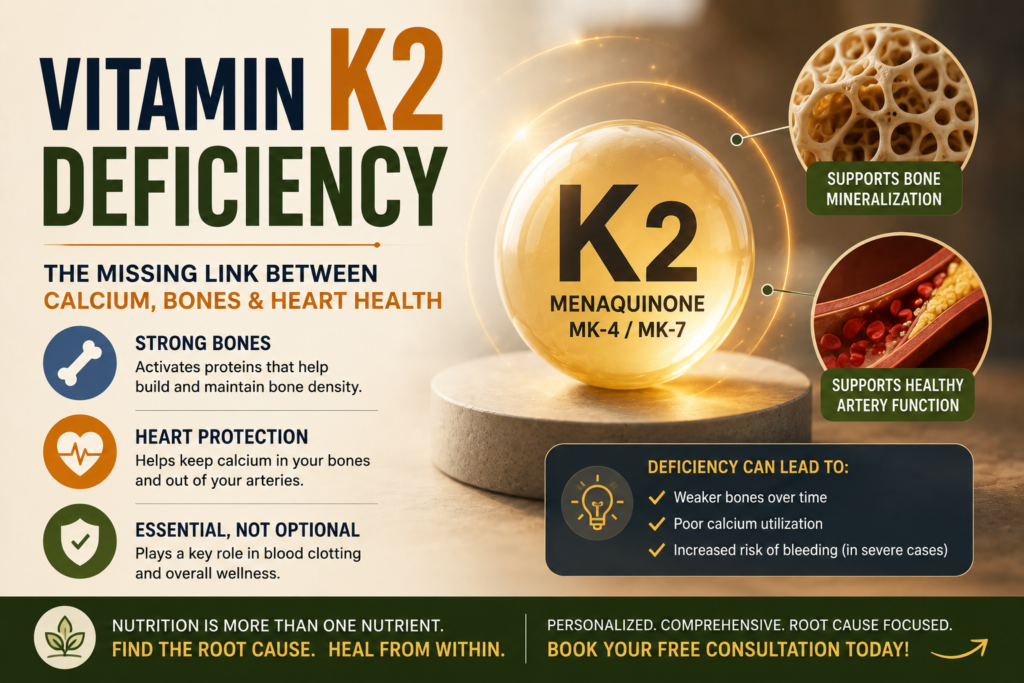
Vitamin K also participates in proteins involved in normal bone metabolism, and certain forms known as Vitamin K2 have attracted growing interest for their potential role in skeletal health.
If you’re focusing on calcium while ignoring everything that helps your body actually manage its nutrients, you may be looking at only one piece of a much bigger nutritional puzzle.
What Is Vitamin K2?
Vitamin K isn’t one single compound. Vitamin K1 (phylloquinone) is found primarily in green vegetables, while Vitamin K2 refers to a family of compounds called menaquinones, including forms such as MK-4 and MK-7.
These forms differ in where they’re found and how they’re handled by the body.
K2 can be found in certain fermented and animal-derived foods, while intestinal bacteria can also produce menaquinones.
But here’s the important part: Vitamin K is needed to activate specific proteins in your body.
And some of those proteins are involved in your bones.
Why Is Vitamin K2 So Interesting for Bone Health?
Your skeleton isn’t simply a pile of calcium.
Bone is living tissue that is continually being broken down and rebuilt.
Vitamin K is required for the activation of osteocalcin, a protein produced by bone-forming cells that participates in bone mineralization.
This is one reason scientists have investigated whether different forms of vitamin K—particularly K2—could influence bone health.
But it also demonstrates something much bigger:
Having a nutrient inside your body isn’t always enough. Your body needs the biological machinery required to use it.
That’s why nutrition is about more than simply consuming large amounts of individual nutrients.
Calcium Alone Isn’t the Whole Story
For decades, the conversation around bone health often sounded simple:
“Want stronger bones? Get more calcium.”
But healthy bones depend on numerous factors.
Vitamin D helps regulate calcium absorption and metabolism.
Protein contributes to the structural matrix of bone.
Magnesium participates in bone physiology.
Physical activity stimulates bone remodeling.
Hormones influence bone turnover.
And vitamin K participates in activating bone-related proteins.
So if you’re taking calcium every day while ignoring everything else, you may be oversimplifying a complicated biological system.
Your body doesn’t need one nutrient. It needs nutrients working together.
Can You Actually Be Vitamin K2 Deficient?
This is where online health information can become misleading.
There isn’t a widely accepted clinical diagnosis called “Vitamin K2 deficiency” with its own established symptom checklist.
Medicine generally recognizes vitamin K deficiency, particularly when it becomes severe enough to impair normal blood clotting.
Vitamin K deficiency is uncommon in healthy adults, although problems with fat absorption, certain medications, or other medical circumstances can increase risk.
So symptoms such as weak bones, fatigue, dental problems, or cardiovascular concerns do not prove that someone is K2 deficient.
That’s important.
A symptom can point toward a problem without telling you exactly what the problem is.
What About Vitamin K2 and Calcium?
This is one of the reasons K2 has become so popular online.
You may have heard statements such as:
“Vitamin K2 puts calcium into your bones instead of your arteries.”
That’s an oversimplification.
Vitamin K-dependent proteins are involved in both bone metabolism and the regulation of abnormal mineralization, which has led researchers to investigate whether vitamin K status could influence cardiovascular health.
That’s scientifically interesting.
But it doesn’t mean taking a K2 supplement automatically “redirects calcium” or prevents cardiovascular disease.
Research is still developing, and health outcomes depend on far more than one vitamin.
Don’t turn an interesting biological mechanism into a guaranteed health result.
What Foods Contain Vitamin K2?
Different menaquinones occur in different foods.
Natto, a traditional fermented soybean food, is particularly rich in MK-7. Certain cheeses and other fermented foods can provide menaquinones, while MK-4 occurs in some animal-derived foods.
Vitamin K1, meanwhile, is abundant in leafy greens such as kale, spinach, collard greens, and broccoli.
Your overall vitamin K status therefore depends on more than finding one “perfect” K2 food.
And there’s another important factor:
Vitamin K is fat-soluble.
That means digestion and absorption matter too.
Eating nutrients and successfully absorbing them are not necessarily the same thing.
What If You’re Eating Well but Still Missing Something?
This is where nutrition becomes much more interesting.
You can eat an apparently healthy diet and still wonder why you’re not getting the results you expected.
Maybe your diet lacks variety.
Maybe another nutrient is inadequate.
Maybe digestion or absorption deserves attention.
Maybe medications are influencing nutrient metabolism.
Or maybe nutrition isn’t the primary explanation for your symptoms at all.
That’s why blindly adding K2 isn’t necessarily the answer.
You first need to ask: “What am I actually trying to correct?”
Should You Take Vitamin K2 With Vitamin D3?
Vitamin D3 and K2 are frequently sold together because both are involved in aspects of bone and calcium metabolism.
That doesn’t mean everyone taking vitamin D must automatically take K2.
Your vitamin D status, diet, medical history, medications, and individual needs all matter.
Supplement combinations can sound scientifically sophisticated while still being completely unnecessary for a particular person.
Remember: More supplements don’t automatically create better nutrition.
A personalized reason for taking something is much more useful than following the latest supplement trend.
A Very Important Warning About Blood Thinners
Vitamin K can interact significantly with vitamin K antagonist anticoagulants such as warfarin.
If you take warfarin, suddenly changing your vitamin K intake—including through K2 supplements—can interfere with anticoagulation.
That doesn’t necessarily mean eliminating vitamin K foods. Consistency of vitamin K intake is generally important for people using warfarin.
Don’t begin Vitamin K2 supplementation or substantially change your vitamin K intake without discussing it with the healthcare professional managing your anticoagulant therapy.
This is a perfect example of why personalized health advice matters.
Something beneficial for one person can be inappropriate for another.
Stop Treating Your Body Like a Supplement Checklist
You’ve probably seen this pattern:
Bones? Take calcium.
Low energy? Take iron.
Muscles? Take magnesium.
Immune system? Take zinc.
Bone health again? Add vitamin D.
Then someone tells you that vitamin D needs K2.
Suddenly you’re taking eight supplements—but have you actually determined what your body needs?
That’s the problem with treating nutrition as a checklist.
Your nutrients interact.
Your organs interact.
Your hormones interact.
Your lifestyle matters.
Your medications matter.
Your digestion matters.
Your entire body operates as a system.
So why would you approach your health as though every symptom exists independently?
The Better Question Isn’t “Do I Need K2?”
The better question is: “WHY am I experiencing the problem I’m trying to solve?”
If you’re concerned about bone health, for example, the answer could involve vitamin D, calcium, vitamin K, protein, hormones, physical activity, medications, aging, genetics—or several factors simultaneously.
Simply taking K2 because you read that it’s “good for bones” doesn’t identify which of those factors deserves attention.
That’s why symptom chasing can become so frustrating.
You keep changing the supplement without changing the strategy.
Look at The Root Cause Instead
At Systemic Body, we don’t assume Vitamin K2—or any other individual nutrient—is the answer to every symptom.
Instead, we look at potential contributing factors through our 6 Root Causes: Nutrition, Toxicity, Alignment, Infections, Emotions, and Mind.
Maybe nutrition deserves attention.
Maybe several nutrients need to be considered together.
Maybe absorption matters.
Maybe something else entirely is contributing.
The objective is to stop guessing and start looking at the bigger picture.
Your Body Needs Balance, Not More Bottles
Vitamin K2 is fascinating because it demonstrates something fundamental about nutrition:
Your body doesn’t simply need nutrients—it needs an entire network of nutrients and biological processes working together.
Calcium alone isn’t the answer.
Vitamin D alone isn’t the answer.
K2 alone isn’t the answer.
Your health is the result of a much larger system.
If you’ve already tried supplement after supplement and you’re still wondering what’s missing, another bottle may not be what you need.
Maybe it’s time for a more personalized approach.
Healthfully,
Systemic Body
Note: I write every post; all this info comes from 10 years of daily testing for my own body.