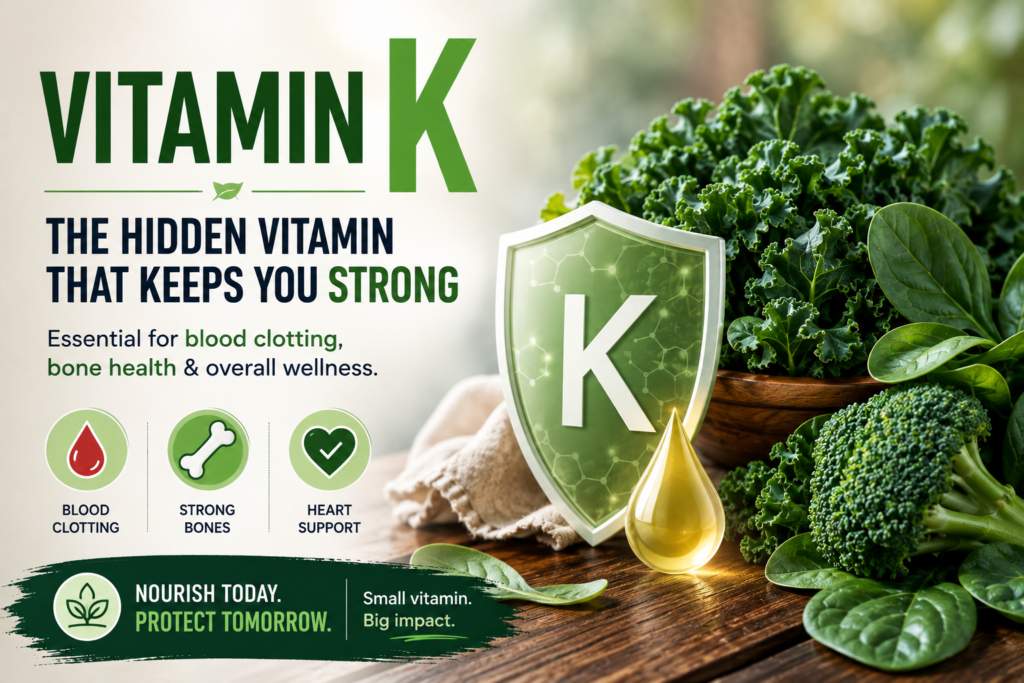
Most people know about vitamin C, vitamin D, and the B vitamins—but vitamin K rarely gets the same attention. Yet your body depends on vitamin K to make proteins involved in normal blood clotting and bone health. When vitamin K becomes severely deficient, your blood can take longer to clot, increasing the risk of abnormal bruising and bleeding.
What Is Vitamin K?
Vitamin K is a fat-soluble vitamin, which means it is absorbed along with dietary fat. The two major forms are vitamin K1 (phylloquinone), found primarily in plant foods, and vitamin K2 (menaquinones), a group of compounds found in certain foods and also produced in small amounts by intestinal bacteria.
But vitamin K isn’t simply another nutrient on a nutrition label.
Your body uses it to activate proteins that perform important jobs.
That includes proteins involved in blood clotting and bone metabolism.
And that’s why getting enough matters.
Why Does Your Body Need Vitamin K?
Imagine getting a small cut.
Your body needs to stop the bleeding.
That process depends on a carefully coordinated clotting system involving platelets and proteins known as clotting factors. Vitamin K is required for your body to produce several of the proteins involved in normal coagulation.
Without adequate vitamin K, normal clotting can become impaired.
But vitamin K’s role doesn’t stop with your blood.
It’s also involved in proteins associated with healthy bones, which is one reason researchers continue studying the relationship between vitamin K intake and bone strength.
One vitamin. Multiple important systems.
What Happens When You’re Vitamin K Deficient?
True vitamin K deficiency is uncommon in healthy adults, but when severe deficiency occurs, the consequences can be significant.
The classic problem is abnormal bleeding.
Someone with vitamin K deficiency may experience easier bruising or bleeding because their blood takes longer to clot. Severe deficiency may also negatively affect bone strength.
But there’s an important distinction:
Not every bruise means you’re deficient in vitamin K.
Easy bruising and abnormal bleeding can also result from medications, platelet disorders, liver disease, inherited clotting disorders, and other conditions.
That’s why matching one symptom to one vitamin can send you in the wrong direction.
Are You Treating the Symptom—or Looking for the Reason Behind It?
This is where many people get stuck.
You notice bruising.
You search online.
Vitamin K appears.
You buy a supplement.
But did you actually determine why you’re bruising?
Maybe vitamin K deserves attention.
Maybe another nutritional issue is involved.
Maybe you’re taking a medication that’s contributing.
Maybe there’s an absorption problem.
Or maybe the explanation isn’t nutritional at all.
Your symptoms can give you valuable information—but they aren’t a diagnosis by themselves.
And that’s why blindly adding another supplement isn’t always the solution.
Who Is More Vulnerable to Vitamin K Deficiency?
For most healthy adults eating a varied diet, deficiency is unusual. However, risk can increase when the body has difficulty absorbing fat, because vitamin K is fat-soluble.
Conditions affecting nutrient absorption can therefore interfere with vitamin K absorption, and people who have undergone certain forms of bariatric surgery may also have greater difficulty maintaining adequate vitamin K status.
Certain medications can affect vitamin K as well.
This reveals an important nutritional principle:
What you eat isn’t necessarily the same thing as what your body successfully absorbs and uses.
What Foods Contain Vitamin K?
Vitamin K1 is abundant in green leafy vegetables, including foods such as kale, spinach, collard greens, and other greens. Vegetable oils such as soybean and canola oil can also contribute vitamin K.
For many people, consistently eating a varied whole-food diet can provide adequate vitamin K.
But nutrition isn’t about finding one “vitamin K superfood.”
Your body needs vitamin K alongside protein, minerals, essential fats, and numerous other vitamins to maintain normal biological functions.
That’s why we prefer looking at the complete nutritional picture.
What About Vitamin K1 vs. Vitamin K2?
You’ve probably seen vitamin K2 heavily promoted online.
Vitamin K1 and K2 aren’t identical. K1 is the predominant dietary form found in leafy green vegetables, while menaquinones collectively make up vitamin K2.
Supplement manufacturers frequently market K2—especially forms such as MK-4 and MK-7—for bone and cardiovascular health.
There is legitimate scientific interest in these areas, but that doesn’t mean everyone needs a high-dose K2 supplement, nor does it mean taking K2 will automatically prevent osteoporosis or cardiovascular disease.
Research on vitamin K supplementation and bone outcomes, for example, has produced mixed findings.
The important question remains: What does YOU actually need?
Should You Take a Vitamin K Supplement?
Not automatically.
Vitamin K is essential, but experiencing symptoms you associate with deficiency doesn’t prove that supplementation is necessary.
There’s another particularly important consideration:
Are You Taking Warfarin?
If you take warfarin (Coumadin) or a similar vitamin K–antagonist medication, changing your vitamin K intake can affect how the medication works.
The goal generally isn’t to eliminate vitamin K-containing foods; maintaining a consistent vitamin K intake is important when taking warfarin. Supplement changes should be discussed with the healthcare professional managing your anticoagulation.
This is exactly why: “I heard this vitamin is healthy, so I’ll take more” isn’t a personalized health strategy.
Nutrition Isn’t Just About What You Eat
You could eat nutritious foods every day and still have factors affecting how your body handles nutrients.
Digestion matters.
Absorption matters.
Your medications matter.
Your overall diet matters.
Your health history matters.
And the interactions between nutrients matter.
Your body isn’t a collection of independent vitamins—it is an interconnected system.
That’s why focusing exclusively on vitamin K while ignoring everything around it may miss the bigger picture.
Stop Chasing One Nutrient After Another
Maybe you’ve already experienced this cycle.
You’re tired, so you buy iron.
You have muscle problems, so you buy magnesium.
You read about immunity, so you buy zinc.
Then vitamin D.
Then vitamin K.
Then something else.
Soon you have an entire shelf of supplements—but you’re still searching for the reason you don’t feel the way you want to feel.
At some point, the question needs to change.
Stop asking: “Which supplement should I take for this symptom?”
Start asking: “WHY is this symptom happening?”
That’s where investigating the bigger picture begins.
This Is Why We Look for the Root Cause
At Systemic Body, we don’t believe every symptom can be solved by taking another vitamin.
Instead, we look at potential contributing factors through our 6 Root Causes: Nutrition, Toxicity, Alignment, Infections, Emotions, and Mind.
Sometimes nutrition deserves attention.
Sometimes absorption may matter.
Sometimes something completely different is contributing.
And sometimes multiple factors are interacting at the same time.
The objective isn’t to sell your body another quick fix.
It’s to understand what deserves attention in the first place.
Your Body Needs the Right Nutrients—not Random Supplements
Vitamin K demonstrates just how interconnected nutrition really is.
Your body requires relatively small amounts, yet those amounts participate in essential functions involving normal blood clotting and healthy bones.
But knowing that vitamin K is important doesn’t tell you whether vitamin K is the reason behind your particular symptoms.
That’s the difference between understanding nutrition and simply guessing.
If you’ve spent months trying different diets, supplements, foods, and protocols without getting the results you expected, maybe you don’t need another random product.
Maybe you need a more personalized strategy.
Healthfully,
Systemic Body
Note: I write every post; all this info comes from 10 years of daily testing for my own body.