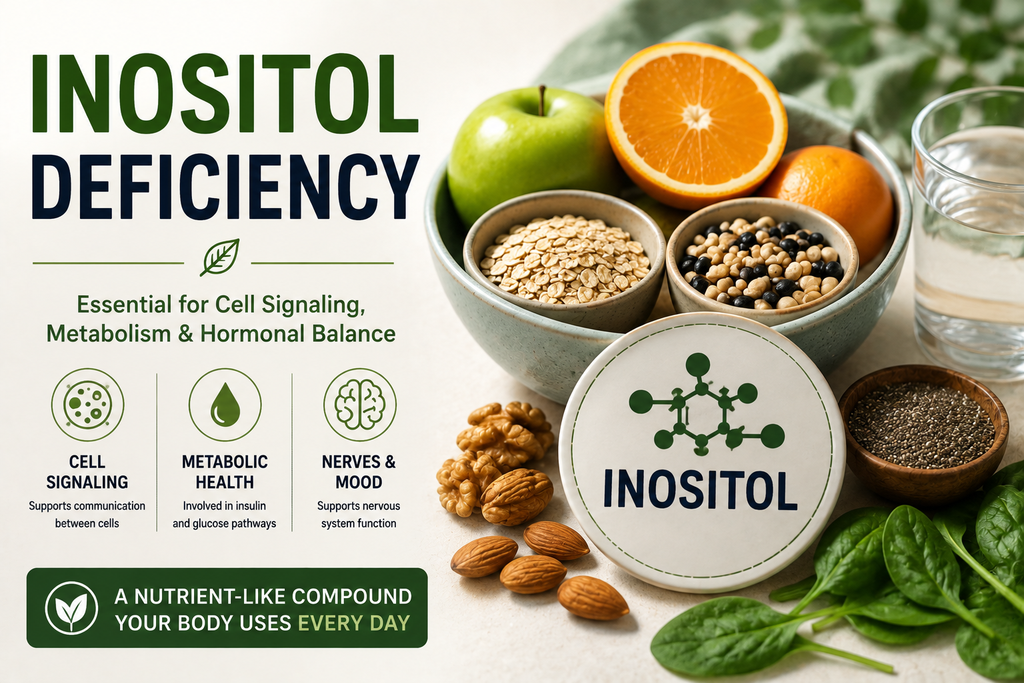
Inositol doesn’t have the name recognition of magnesium, Vitamin D, or the B vitamins. In fact, many people only discover it after seeing myo-inositol on a supplement bottle.
Yet inositol is naturally present throughout the human body and participates in cell signaling, insulin-related pathways, and nervous-system function.
But there’s an important difference between inositol and the vitamins we’ve discussed previously:
Inositol is not officially recognized as an essential vitamin, and there is no established human “inositol deficiency disease.”
Your body can actually manufacture inositol itself.
So the interesting question isn’t simply, “Am I deficient?”
It’s what does inositol actually do—and when might additional inositol be useful?
First, Inositol Isn’t Really Vitamin B8
You may see inositol called “Vitamin B8.”
It’s a convenient nickname, but technically it isn’t correct.
Unlike essential vitamins that your body must obtain from the diet in adequate amounts, humans can synthesize inositol internally, particularly from glucose.
Inositol also occurs naturally in foods.
There are several forms—or stereoisomers—of inositol, but the one you’ll hear about most frequently is myo-inositol. Another important form is D-chiro-inositol.
Both have attracted considerable research interest because of their roles in cellular signaling and metabolism.
Think of Inositol as Part of Your Cells’ Communication System
Your cells constantly receive instructions.
Respond to insulin.
Release hormones.
Transmit nerve signals.
Grow.
Adapt.
Use energy.
To accomplish all of this, cells need ways of carrying messages from the outside of the cell to machinery inside it.
Inositol-containing compounds participate in these cellular signaling pathways.
That’s why inositol has been studied in areas involving metabolism, insulin signaling, reproductive health, and the nervous system.
It isn’t simply another “energy vitamin.”
It participates in the communication network helping cells respond to their environment.
Can You Actually Become Inositol Deficient?
This is where we need to be careful.
There is currently no established clinical diagnosis of nutritional inositol deficiency in otherwise healthy humans comparable to iron-deficiency anemia, scurvy from Vitamin C deficiency, or pellagra from niacin deficiency.
There’s no standard symptom checklist where a physician can say:
“You have these five symptoms, therefore you’re inositol deficient.”
And there isn’t an established Recommended Dietary Allowance specifically designed to prevent an inositol-deficiency disease.
That means claims such as: “Anxiety means you’re deficient in inositol.”
or “Insulin resistance is caused by inositol deficiency.”
are far too simplistic.
Inositol may participate in those biological systems.
That doesn’t mean inadequate inositol is automatically their cause.
Then Why Is Everyone Talking About Myo-Inositol?
A major reason is metabolic and reproductive health research.
Myo-inositol and D-chiro-inositol participate in pathways related to insulin signaling, and supplements containing these compounds have been studied particularly in people with polycystic ovary syndrome (PCOS).
Some research suggests inositol supplementation may improve certain metabolic and reproductive outcomes in some people with PCOS.
That’s genuinely interesting.
But notice the wording:
Studied as a supplement for a particular condition does not mean the condition itself is an “inositol deficiency.”
Those are two completely different claims.
A compound can influence a biological pathway without a disease being caused by deficiency of that compound.
What Does Insulin Have to Do With It?
After you eat carbohydrates, blood glucose rises.
Your pancreas releases insulin, which acts as a signal helping regulate how glucose is handled throughout the body.
But insulin doesn’t work alone.
Its message has to be communicated through complex intracellular pathways.
Inositol-derived molecules participate in parts of this signaling system.
This connection is one reason researchers have explored inositol in insulin resistance and PCOS.
However, insulin resistance itself can be influenced by numerous factors, including body composition, physical activity, genetics, sleep, diet, medications, hormones, and other metabolic factors.
So taking inositol while ignoring everything else would miss the bigger picture.
Inositol and the Brain
The brain is another reason inositol has attracted attention.
Inositol compounds participate in neuronal signaling, and researchers have investigated supplemental inositol in areas involving mood, anxiety, panic disorder, and other psychiatric conditions.
Results haven’t established inositol as a universal treatment.
That’s important because supplement marketing often jumps from:
“This compound participates in brain signaling.”
to: “Take this and you’ll feel calmer.”
Biology doesn’t work that neatly.
Your mood and nervous system depend on an enormous network involving neurotransmitters, hormones, sleep, nutrition, stress, medications, medical conditions, and life circumstances.
One pathway rarely explains the whole person.
Your Body Already Makes Inositol—And Food Provides It Too
Inositol and its related compounds occur naturally in many foods.
Sources include fruits, beans, whole grains, nuts, and seeds, with amounts varying according to the food and how it’s processed.
Your body can also synthesize myo-inositol from glucose.
So unlike an essential nutrient that must come entirely from your diet, the inositol story involves both dietary intake and endogenous production.
That makes calling ordinary low intake an “inositol deficiency” particularly misleading.
What About Inositol Supplements?
Inositol supplements commonly provide myo-inositol, D-chiro-inositol, or combinations of both.
They’re particularly popular in products marketed toward women with PCOS, fertility concerns, or insulin resistance.
And supplementation may be appropriate in certain circumstances.
But the question shouldn’t be: “Is inositol healthy?”
Almost anything involved in human physiology could be described that way.
The useful question is: “Why am I considering taking it?”
If there’s a specific evidence-based reason, supplementation can be discussed intelligently.
If the reason is simply that an influencer listed ten symptoms of “inositol deficiency,” you may be solving a problem you haven’t established exists.
More Isn’t Automatically Better
Inositol is generally considered well tolerated at commonly studied amounts, but supplements can still produce side effects.
Higher amounts may cause nausea, abdominal discomfort, gas, diarrhea, headache, or dizziness in some people.
And taking more doesn’t necessarily produce a better result.
That’s a principle worth remembering with every supplement:
The goal isn’t maximum intake. The goal is appropriate intake for the right reason.
Here’s the Problem With Diagnosing Yourself Through Symptoms
Suppose you’re dealing with:
Low energy.
Cravings.
Difficulty concentrating.
Mood changes.
Irregular cycles.
Weight changes.
You search online and discover an article claiming all of these indicate low inositol.
It sounds convincing because you recognize yourself in the list.
But those symptoms can occur for many different reasons.
Hormonal conditions.
Blood-sugar regulation.
Sleep deprivation.
Stress.
Medication effects.
Nutritional problems.
Thyroid disorders.
And numerous other possibilities.
Recognizing your symptoms isn’t the same thing as identifying their cause.
That’s where supplement roulette begins.
Maybe You Don’t Need Another Supplement
This is something we encourage people to consider at Systemic Body.
If you’ve already tried magnesium, Vitamin D, B vitamins, probiotics, herbs, adaptogens, and now inositol…
…but you’re still searching for answers…
perhaps the problem isn’t that you haven’t found the right bottle yet.
Perhaps the strategy itself needs to change.
Instead of continually asking: “What can I take for this symptom?”
start asking: “Why is my body producing this symptom?”
That question takes you somewhere completely different.
We Look Beyond One Nutrient
At Systemic Body, we consider potential contributing factors through our 6 Root Causes: Nutrition, Toxicity, Alignment, Infections, Emotions, and Mind.
Nutrition can absolutely matter.
But even when nutrition is involved, it may not be about one nutrient.
Diet quality matters.
Protein matters.
Micronutrients matter.
Digestion and absorption matter.
Metabolic health matters.
Lifestyle matters.
And sometimes the biggest contributor lies somewhere else entirely.
That’s why we don’t believe everyone with the same symptom should automatically receive the same protocol.
Your Body Isn’t a Collection of Separate Problems
Your hormones communicate with your brain.
Your brain communicates with your digestive system.
Your metabolism responds to sleep.
Your food affects your blood glucose.
Your physical activity affects insulin sensitivity.
Your nutrients participate in thousands of biochemical reactions.
Everything interacts.
Inositol itself demonstrates this beautifully because its major biological importance involves signaling and communication.
So why approach your health as though every symptom exists independently?
Stop Asking “Which Supplement?” First
Inositol is biologically important.
Myo-inositol has legitimate areas of scientific research.
Supplementation may be useful for certain people.
But that doesn’t mean every person experiencing metabolic, hormonal, or neurological symptoms has an inositol deficiency.
Before adding another supplement, understand the problem you’re actually trying to solve.
Because taking the right nutrient for the wrong reason still leaves the original question unanswered.
Maybe It’s Time to Look at the Whole Picture
If you’ve spent months—or years—experimenting with supplements while the same symptoms continue returning, consider changing the question.
Don’t just ask: “What should I take?”
Ask: “WHY is this happening?”
At Systemic Body, our goal is to look beyond isolated symptoms and consider the potential factors contributing to your individual situation.
Healthfully,
Systemic Body
Note: I write every post; all this info comes from 10 years of daily testing for my own body.