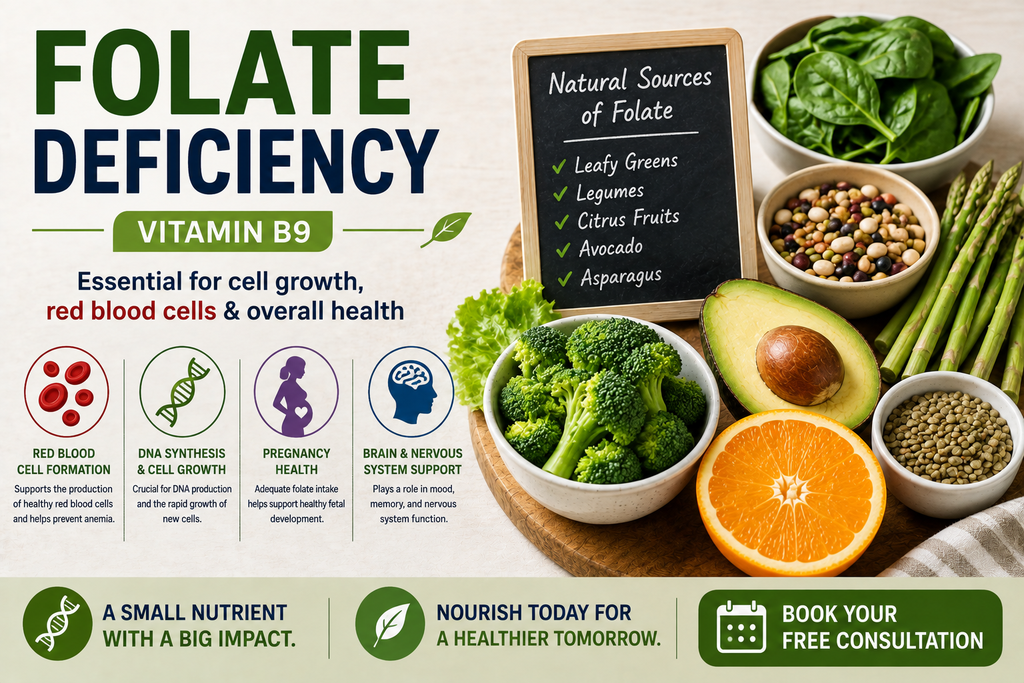
Every day, your body creates new cells, produces red blood cells, copies DNA, repairs tissues, and replaces cells that have reached the end of their lifespan. Folate—also known as Vitamin B9—is deeply involved in these processes.
Unlike some trendy nutrients with loosely defined “deficiency” claims, folate deficiency is real, measurable, and potentially serious. When folate becomes inadequate, rapidly dividing cells are particularly vulnerable, which helps explain why deficiency can affect your blood and why adequate folate is especially important during pregnancy.
But there’s a catch: some signs of folate deficiency can resemble other nutritional problems—especially Vitamin B12 deficiency.
So simply buying folic acid because you’re tired isn’t necessarily the right answer.
Folate, Folic Acid, B9… What’s the Difference?
These terms are often used interchangeably, but they aren’t the same.
Folate is the general term for forms of Vitamin B9 found naturally in foods and present in the body.
Folic acid is a synthetic form commonly used in fortified foods and dietary supplements.
You may also encounter supplements containing 5-MTHF (5-methyltetrahydrofolate), sometimes marketed as “methylfolate.”
Regardless of the form, Vitamin B9 ultimately participates in some extraordinarily important biological processes.
One of the biggest?
Making DNA.
Your Body Is Constantly Building New Cells
Consider what happens inside your bone marrow.
Your body is continually producing new blood cells.
Those developing cells need to grow and divide—and cell division requires DNA synthesis.
Folate participates in reactions necessary for making DNA and other genetic material.
When folate becomes severely inadequate, cells may struggle to divide normally.
This can lead to megaloblastic anemia, in which abnormally large, immature red blood cells are produced.
And that’s when symptoms may begin becoming noticeable.
Why Can Folate Deficiency Make You Feel Exhausted?
Red blood cells help transport oxygen throughout your body.
When folate deficiency contributes to anemia, you may experience symptoms such as:
Fatigue, weakness, difficulty concentrating, irritability, headache, heart palpitations, or shortness of breath.
But there’s an important problem.
Read that list again.
Almost none of those symptoms uniquely identifies folate deficiency.
Iron deficiency can produce fatigue.
Vitamin B12 deficiency can produce fatigue.
Poor sleep can produce fatigue.
Thyroid disorders can produce fatigue.
Numerous illnesses can produce fatigue.
Feeling tired tells you something may deserve attention. It doesn’t tell you which supplement to buy.
Your Mouth May Provide Clues Too
Folate deficiency can sometimes affect tissues with rapid cellular turnover.
A person may develop changes to the tongue or sores inside the mouth, alongside other symptoms.
Again, these aren’t exclusive to folate.
That’s why we need to stop thinking of symptoms as nutritional labels.
Your tongue doesn’t come with a notification saying: “Vitamin B9 low. Please insert folic acid.”
The body is more complicated than that.
Symptoms are pieces of information that need context.
Pregnancy Is Where Folate Becomes Especially Important
Folate has a particularly important role before and during early pregnancy.
Adequate folic acid intake around conception and during early pregnancy significantly reduces the risk of serious fetal neural tube defects, including spina bifida and anencephaly.
This is why public-health recommendations advise people who could become pregnant to obtain adequate folic acid, in addition to consuming folate from a varied diet.
And timing matters.
The neural tube develops very early—sometimes before someone even realizes they’re pregnant.
This isn’t simply supplement marketing.
It’s one of the clearest examples of nutrition influencing early human development.
People who are pregnant, trying to conceive, or who could become pregnant should follow appropriate professional/public-health guidance regarding folic acid intake rather than relying on generalized supplement advice.
Why Would Someone Become Folate Deficient?
Sometimes the explanation is straightforward: not enough folate is being consumed.
But that’s not the only possibility.
Folate status can also be affected by malabsorption, increased requirements, heavy alcohol consumption, and certain medications.
Pregnancy increases folate requirements because of rapid maternal and fetal tissue growth.
This brings us back to something easy to overlook:
A deficiency isn’t always just a food problem.
You can ask what someone eats.
But you may also need to ask what they’re absorbing, what their body requires, and whether something is interfering with normal nutrient metabolism.
Where Does Folate Come From?
Fortunately, nature gives us plenty of options.
Folate occurs naturally in foods such as dark leafy green vegetables, beans, peas, lentils, asparagus, Brussels sprouts, oranges, avocado, and liver.
Many grain products are also fortified with folic acid in countries that require or permit fortification.
Even the name gives you a hint.
“Folate” comes from the same root associated with foliage—think leafy greens.
But don’t turn this into: “Eat spinach and everything is solved.”
Your body needs far more than folate.
Healthy blood production alone involves numerous nutrients, including iron, Vitamin B12, Vitamin B6, protein, and others.
Nutrition works as a network.
There’s One Big Reason You Shouldn’t Blindly Take High-Dose Folic Acid
Vitamin B12 deficiency can also cause megaloblastic anemia.
That’s important because large amounts of folic acid can correct the anemia caused by B12 deficiency without necessarily correcting the neurological damage associated with B12 deficiency.
In other words, one visible clue can improve while the underlying B12 problem remains.
That’s exactly why treating yourself based purely on symptoms can be problematic.
You may think: “My folate must be low.”
But what if it’s B12?
What if it’s iron?
What if it’s something entirely different?
The objective shouldn’t be to make one symptom disappear while missing the reason it appeared.
What About MTHFR?
You’ve probably seen this acronym if you’ve spent any time researching folate online.
MTHFR is an enzyme involved in folate metabolism, and genetic variants in the MTHFR gene are relatively common.
Unfortunately, online discussions sometimes make these variants sound like catastrophic mutations that mean someone “can’t process folic acid.”
That’s usually an oversimplification.
Certain MTHFR variants can influence folate metabolism, but having a common variant does not automatically mean you’re folate deficient or that you require expensive specialized supplements.
This is another area where personalized information matters more than fear-based marketing.
A genetic result needs context too.
Is Methylfolate Better Than Folic Acid?
Supplement companies often position 5-MTHF or methylfolate as a universally superior form of Vitamin B9.
There are situations where different folate forms may be considered.
But “methylated” doesn’t automatically mean “better for everyone.”
Folic acid has extensive evidence supporting its ability to help prevent neural tube defects when used according to established recommendations.
So don’t choose a supplement simply because its label sounds more advanced.
First determine: What are you actually trying to accomplish?
That question should come before the product.
Maybe Your Fatigue Isn’t a Folate Problem
This is where people often get stuck.
You’re tired.
You Google deficiencies.
Folate appears.
You buy B9.
Then you discover B12.
You add that.
Then iron.
Then magnesium.
Eventually, your supplement cabinet becomes increasingly impressive…
but you still don’t know why you’re tired.
That’s the weakness of symptom-based supplementation.
It gives you endless possibilities without necessarily identifying the correct one.
Instead of continually asking: “What deficiency causes my symptoms?”
try asking: “What is actually causing MY symptoms?”
Those questions sound similar.
They’re not.
That’s Where Our Approach Is Different
At Systemic Body, nutrition is an important part of the picture—but we don’t assume every chronic symptom is caused by a vitamin deficiency.
We consider potential contributing factors through our 6 Root Causes: Nutrition, Toxicity, Alignment, Infections, Emotions, and Mind.
If nutrition appears important, we don’t necessarily stop at one vitamin either.
Folate interacts with other nutrients.
B12 matters.
Iron matters.
Protein matters.
Digestion and absorption matter.
Your overall dietary pattern matters.
Your body doesn’t experience nutrients one supplement bottle at a time.
Neither should your health strategy.
Stop Matching Symptoms to Supplements
A deficiency should be corrected when it exists.
That’s straightforward.
But randomly supplementing because your symptoms resemble an online list is different.
If you’ve already tried vitamin after vitamin and still feel like something is missing, perhaps you don’t need another guess.
Maybe you need a more individualized investigation.
Your symptoms are clues.
Your diet provides clues.
Your history provides clues.
The goal is to connect them rather than continually chasing whichever nutrient happens to be trending.
Your Body Deserves More Than Trial and Error
Folate is essential.
Your cells need it.
Your blood depends on it.
And during early pregnancy, adequate folate becomes particularly important.
But knowing all of that still doesn’t answer the question that matters most to you:
“What does MY body actually need?”
That’s where personalized health begins.
If you’ve spent months—or years—experimenting with diets and supplements without getting the results you’re looking for, consider changing the strategy rather than simply changing the supplement.
Healthfully,
Systemic Body
Note: I write every post; all this info comes from 10 years of daily testing for my own body.