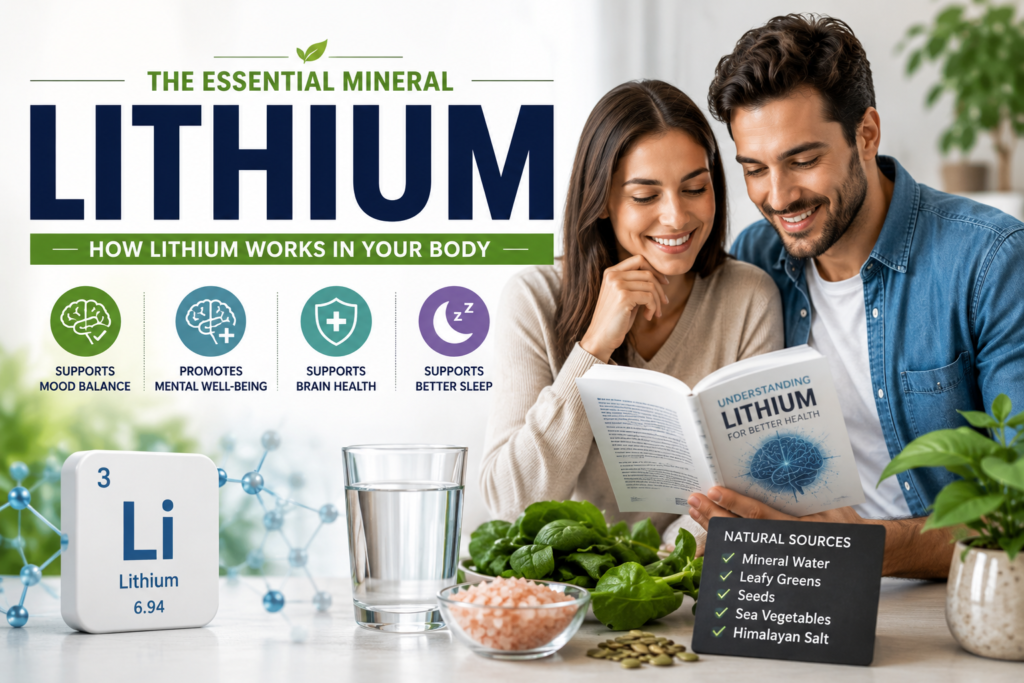
When you hear the word lithium, you probably think of the prescription medication used in psychiatry. But here’s what many people don’t realize: lithium also occurs naturally in soil, water, and food, meaning humans regularly consume tiny amounts of it through the environment and diet.
Researchers have investigated whether these nutritional amounts could play a role in human health—but lithium’s nutritional significance is still far from fully understood.
What Is Lithium?
Lithium is a naturally occurring element found in varying concentrations in drinking water, grains, vegetables, and other foods.
The amounts obtained through food and water are dramatically lower than the doses used medically.
That’s an important distinction.
Nutritional exposure to lithium and prescription lithium therapy are not the same thing.
Prescription lithium is a medication with established medical uses that requires professional supervision and blood monitoring because excessive levels can become toxic.
At the nutritional level, researchers have explored whether tiny amounts of naturally occurring lithium might have biological effects—but there is currently no established Recommended Dietary Allowance (RDA) for lithium and no officially recognized lithium-deficiency disease in humans.
So why talk about it?
Because nutrition isn’t limited to the handful of minerals printed on the front of supplement bottles.
Is Lithium Actually an Essential Nutrient?
At this point, lithium has not been officially established as an essential nutrient for humans.
Some researchers have proposed that very small amounts could potentially have physiological importance, and lithium has sometimes been described as a potentially beneficial or conditionally essential trace element.
But the evidence isn’t strong enough to say that humans require a specific daily amount or that low dietary intake causes a predictable set of symptoms.
This means claims such as: “You’re tired because you’re lithium deficient.”
or “Low lithium causes anxiety or depression.”
go beyond what the evidence can currently establish.
However, lithium remains scientifically interesting precisely because very small amounts naturally enter the human body throughout life.
Why Are Researchers Interested in Trace Lithium?
Lithium interacts with several biological pathways, particularly within the nervous system.
At prescription doses, its effects on the brain are well established enough that lithium medications have been used for decades in the treatment of certain psychiatric conditions.
Researchers have also investigated whether much lower environmental exposure to lithium—such as naturally occurring lithium in drinking water—might correlate with certain population-level mental-health outcomes.
Some observational studies have reported interesting associations.
But association isn’t proof.
Differences between populations, environmental factors, socioeconomic conditions, healthcare access, and many other variables can influence these findings.
That’s why naturally occurring lithium remains an interesting area of research—not a proven nutritional treatment.
Can You Become Lithium Deficient?
This is where we need to separate marketing from science.
There is currently no universally accepted medical diagnosis of nutritional lithium deficiency.
There isn’t a standard blood test that tells a generally healthy person, “You’re nutritionally lithium deficient.”
There isn’t an established collection of deficiency symptoms comparable to iron-deficiency anemia.
And there isn’t an official daily requirement that everyone must consume to prevent deficiency.
So if you’re experiencing low mood, irritability, difficulty concentrating, poor sleep, fatigue, or emotional changes, you should not automatically conclude that you need lithium.
Those symptoms can have countless nutritional, psychological, medical, environmental, and lifestyle explanations.
Symptoms are clues. They aren’t proof of a specific deficiency.
And that’s exactly why looking at the bigger picture matters.
The Bigger Question: What Is Your Body Actually Missing?
This is where people can get trapped.
You’re tired.
You search online.
Someone says magnesium.
You try magnesium.
Then you read about iron.
Then zinc.
Then lithium.
Before long, your cabinet contains 15 different supplements—and you’re still trying to figure out why you don’t feel right.
The problem isn’t necessarily that you haven’t discovered the right supplement yet.
The problem may be that you’re trying to solve a complex problem one nutrient at a time.
Your body doesn’t work that way.
Your nervous system alone depends on adequate energy, amino acids, essential fatty acids, vitamins, minerals, hormones, sleep, stress regulation, and numerous other factors.
That’s why the better question isn’t: “Am I lithium deficient?”
It’s: “What factors could actually be contributing to what I’m experiencing?”
Where Does Natural Lithium Come From?
Humans can consume trace amounts of lithium through water and food, although concentrations vary substantially according to geography and soil composition.
Plant foods can contain lithium absorbed from the soil, while drinking-water concentrations depend heavily on local geology.
This means two people eating similar diets in different parts of the world may naturally consume different amounts.
But remember: the existence of lithium in food doesn’t automatically prove that humans require a particular dietary intake.
That’s an area science is still investigating.
Should You Take a Lithium Supplement?
Don’t assume that you should.
This deserves more caution than many ordinary nutritional supplements.
Lithium can affect the kidneys, thyroid, nervous system, and fluid/electrolyte balance, particularly at pharmacological doses. Prescription lithium can also interact with medications and requires medical monitoring.
Even products marketed as low-dose lithium supplements shouldn’t be treated as harmless simply because they’re available without a prescription in some places.
And never substitute an over-the-counter lithium product for prescribed lithium or alter prescribed lithium treatment without your healthcare professional.
The principle is simple: Don’t supplement something just because its benefits sound appealing. Understand why you’re taking it first.
More Supplements Don’t Automatically Mean Better Health
It’s easy to believe that if a little of something might be beneficial, more must be better.
Nutrition doesn’t work that way.
Your body depends on balance.
Too little of an essential nutrient can create problems.
Too much can create completely different problems.
And sometimes the nutrient you’re focusing on isn’t the problem at all.
This is why randomly stacking supplements can become counterproductive.
The goal isn’t to take everything your body could use. The goal is to understand what your body actually needs.
Stop Matching Every Symptom to a Supplement
If you’ve been struggling with persistent symptoms, you’ve probably seen articles claiming that nearly every vitamin or mineral could be the missing answer.
The headlines sound convincing.
The symptoms sound familiar.
And suddenly you’re convinced you’ve found your problem.
But ask yourself: How many times have you already thought that?
If you’ve repeatedly changed diets, bought supplements, eliminated foods, or followed health trends without getting the results you expected, perhaps it’s time to stop chasing individual symptoms.
Start looking at the whole system instead.
Look for the Root Cause
At Systemic Body, our approach isn’t based on assuming lithium—or any single nutrient—is responsible for everything you’re experiencing.
We look at potential contributing factors through our 6 Root Causes: Nutrition, Toxicity, Alignment, Infections, Emotions, and Mind.
Sometimes nutrition deserves attention.
Sometimes another factor may be more important.
And sometimes several things may be interacting simultaneously.
That’s why a customized approach matters.
Instead of asking: “Which supplement should I try next?”
Start asking: “WHY am I experiencing these symptoms in the first place?”
That’s a much more powerful question.
Your Body Deserves More Than Guesswork
Lithium is a fascinating trace element, and future research may tell us much more about the significance of the tiny amounts humans naturally consume.
But you don’t have to wait for the next supplement trend to start taking a better approach to your health.
If you’ve been dealing with persistent symptoms and nothing you’ve tried seems to address the bigger picture, stop randomly experimenting and start investigating what may actually deserve attention.
Stop Guessing. Start Looking for Answers.
At Systemic Body, we take a personalized approach designed to look beyond individual symptoms and consider the bigger picture.
Don’t spend another few months jumping from one supplement to another.
Note: I write every post; all this info comes from 10 years of daily testing for my own body.