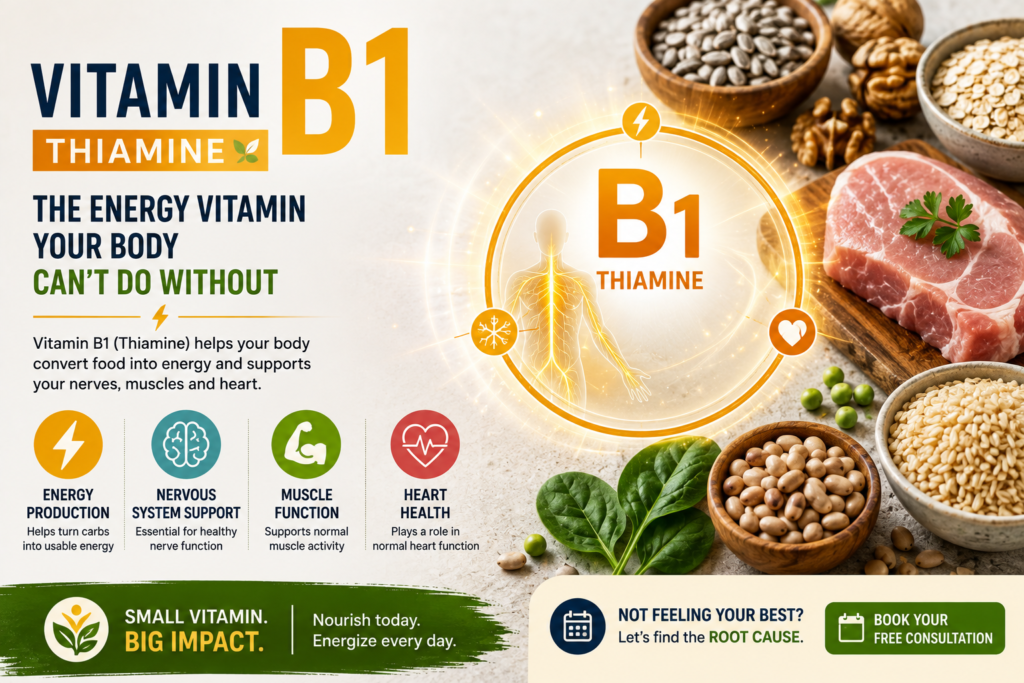
Feeling exhausted even though you’re eating enough? Experiencing weakness, poor appetite, tingling, or changes in concentration? Sometimes the problem isn’t simply how much food you’re eating—it’s whether your body has the micronutrients required to turn that food into usable energy.
Vitamin B1, also known as thiamine, is one of those essential nutrients, and when your body doesn’t get enough, the consequences can become serious.
What Is Vitamin B1?
Vitamin B1, or thiamine, is a water-soluble B vitamin your body needs every day.
One of its most important jobs involves helping enzymes convert nutrients—particularly carbohydrates—into energy your cells can use.
But thiamine isn’t simply an “energy vitamin.”
It is also essential for the normal function of your nervous system, muscles, and heart.
And because your body stores only relatively small amounts of thiamine, maintaining an adequate dietary supply matters.
You can eat plenty of calories and still not necessarily provide your body with every micronutrient it needs to properly use those calories.
That’s an important difference.
Why Does Your Body Need Thiamine?
When you eat carbohydrates, your body breaks them down into glucose.
But glucose doesn’t magically become cellular energy.
Your body needs enzymes and nutritional cofactors to process it through multiple metabolic pathways—and thiamine is required by several important enzymes involved in energy metabolism.
This is particularly significant for tissues with high energy requirements, including your brain, nerves, and heart.
Think about it this way: Food provides the fuel. Nutrients help your body use the fuel.
If one of those nutritional pieces becomes severely inadequate, normal metabolism can begin to suffer.
What Happens When You’re Vitamin B1 Deficient?
Early thiamine deficiency can cause relatively nonspecific symptoms, which is one reason it may not immediately be obvious.
Possible symptoms can include:
- Loss of appetite
- Fatigue
- Muscle weakness
- Irritability
- Memory or concentration problems
- Tingling or numbness
- Changes in reflexes
As deficiency becomes more severe, the nervous and cardiovascular systems can be affected.
Severe thiamine deficiency can cause beriberi, while a serious neurological condition called Wernicke encephalopathy can occur in certain high-risk situations.
These aren’t conditions to self-treat with supplements.
Significant neurological symptoms, confusion, difficulty walking, abnormal eye movements, or cardiovascular symptoms require medical attention.
But there’s another lesson here:
A nutrient required in relatively small amounts can still have an enormous effect when the body doesn’t have enough.
Why Can Low B1 Affect Your Energy?
This is where thiamine becomes particularly interesting.
People often think: “I’m tired, so I need more calories.”
But calories aren’t the entire story.
Your cells have to transform nutrients into usable energy, and that process requires micronutrients.
Thiamine is converted into an active form called thiamine pyrophosphate (TPP), which serves as a cofactor for enzymes involved in carbohydrate and amino-acid metabolism.
Without adequate thiamine, these metabolic pathways cannot operate normally.
So when evaluating persistent fatigue, it’s worth remembering:
Energy isn’t just about how much you eat. It’s also about what your body can do with what you eat.
That doesn’t mean fatigue automatically equals B1 deficiency—it absolutely doesn’t.
But it demonstrates why micronutrition deserves attention.
Are You Actually B1 Deficient—or Just Matching Symptoms to a Vitamin?
This distinction matters.
Fatigue?
Could be thiamine—but it could also involve iron, vitamin B12, sleep, thyroid function, medications, stress, calorie intake, illness, or countless other factors.
Tingling?
Thiamine can affect nerves—but so can B12 deficiency, diabetes, nerve compression, medications, and numerous neurological conditions.
Weakness?
Again, dozens of possibilities.
Your symptoms can tell you that something deserves attention. They don’t automatically tell you what’s causing it.
And this is where many people become trapped in supplement roulette.
They search a symptom.
They find a nutrient.
They buy the supplement.
They wait.
Nothing changes.
Then they search again.
Who Is More Likely to Develop Thiamine Deficiency?
True thiamine deficiency is more likely when intake is inadequate, requirements are increased, absorption is impaired, or thiamine is lost more rapidly than normal.
Risk can be higher in certain circumstances, including chronic heavy alcohol use, severe malnutrition, some gastrointestinal conditions or surgeries, prolonged vomiting, and certain medical situations.
Older adults and people with particular health conditions may also be at increased risk.
This highlights an important point: Nutrition isn’t simply about what goes into your mouth.
You have to digest it.
Absorb it.
Convert it.
Use it.
And maintain enough of it for your body’s requirements.
What Foods Contain Vitamin B1?
Thiamine occurs naturally in a variety of foods.
Good sources can include meat, eggs, dairy, legumes, seeds, nuts, etc.
Foods such as beans, lentils, sunflower seeds, whole grains, and pork can contribute meaningful amounts.
Processing can also influence thiamine content, which is one reason many refined grain products are fortified with B vitamins.
A varied diet can therefore provide thiamine alongside many of the other nutrients involved in energy metabolism.
Because remember: Your body doesn’t run on B1 alone.
B1 Doesn’t Work Alone
This is one of the most important concepts to understand.
Thiamine participates in energy metabolism—but so do numerous other nutrients.
Magnesium matters.
Riboflavin matters.
Niacin matters.
Vitamin B6 matters.
Iron matters.
Protein matters.
And many other nutrients participate directly or indirectly in producing and utilizing energy.
That’s why simply taking huge amounts of B1 isn’t necessarily the answer to feeling tired.
Your metabolism is a network—not a single switch.
And if you’re focusing on only one nutrient, you may be missing what is happening around it.
Should You Take a Vitamin B1 Supplement?
Maybe—but don’t assume you need one simply because you recognize some of the symptoms above.
Thiamine supplements can be appropriate when intake is inadequate, or deficiency is suspected or diagnosed, and medical professionals may use thiamine therapeutically in specific circumstances.
But taking a supplement without understanding the problem can create a false sense that you’ve addressed the underlying issue.
This is particularly important when symptoms are persistent or severe.
Don’t use supplementation as a substitute for figuring out why you’re experiencing the symptoms in the first place.
Look For The Root Cause
At Systemic Body, we don’t assume that Vitamin B1—or any individual nutrient—is responsible for everything you’re experiencing.
Instead, we look at potential contributing factors through our 6 Root Causes: Nutrition, Toxicity, Alignment, Infections, Emotions, and Mind.
Maybe your nutritional intake deserves attention.
Maybe nutrient absorption matters.
Maybe another factor is contributing.
Maybe several things are happening simultaneously.
The goal is to stop guessing and start looking at the bigger picture.
Because another supplement may temporarily give you something new to try.
Understanding what’s actually contributing gives you a direction.
If you’ve spent months—or even years—trying different diets, supplements, vitamins, and protocols without getting the results you’re looking for, doing more of the same may not be the answer.
At Systemic Body, we look beyond isolated symptoms and individual nutrients to help build a more personalized approach around the bigger picture.
Healthfully,
Systemic Body
Note: I write every post; all this info comes from 10 years of daily testing for my own body.