A crack at the corner of your mouth. A tongue that suddenly feels unusually sore. Skin that keeps becoming irritated. Eyes that seem more sensitive than usual.
Individually, these problems may not seem connected. But nutrition affects the body in ways that aren’t always obvious—and Vitamin B2 is one nutrient worth knowing about.
Also called riboflavin, Vitamin B2 helps your body release energy from food and supports normal cellular function. Because humans store only limited amounts, we depend on a regular dietary supply.
So instead of asking whether B2 is another vitamin you should add to your supplement cabinet, consider a more useful question: Is your body getting—and properly using—the nutrition it needs?
Meet Riboflavin: One of Your Metabolism’s Helpers
Every meal contains potential energy.
Potential is the important word.
The carbohydrates, fats, and proteins you eat still have to undergo numerous biochemical reactions before your cells can use them. Riboflavin contributes to this process after being converted into two important coenzymes: FAD and FMN.
These compounds participate in reactions involved in energy production, cellular function, and the metabolism of other nutrients.
In simpler terms: Eating the fuel is one thing. Processing it is another.
Vitamin B2 helps with the second part.
When B2 Starts Running Low, Where Might You Notice It?
Vitamin B2 deficiency is known medically as ariboflavinosis.
Unlike vague online “deficiency lists” that attribute almost every imaginable symptom to a single vitamin, riboflavin deficiency has well-recognized clinical features.
Changes can occur around the mouth, tongue, skin, and eyes.
Possible findings include cracks or sores at the corners of the mouth, swollen or cracked lips, a sore or inflamed tongue, skin changes, and eye-related symptoms.
Severe or prolonged deficiency can also occur alongside deficiencies of other nutrients.
And that last point deserves attention.
A person who isn’t getting enough B2 may not be lacking only B2.
If the underlying diet or absorption problem affects one nutrient, others may deserve investigation too.
The Mouth Can Sometimes Reveal More Than You’d Expect
One interesting feature of riboflavin deficiency is how visibly it can affect tissues around the mouth.
Cracking at the corners of the lips—sometimes called angular cheilitis—can occur. The lips may become dry or inflamed, and the tongue can develop noticeable changes.
Does that mean every cracked lip is a B2 deficiency?
No.
Cold weather can contribute.
Dehydration can contribute.
Infections can contribute.
Other nutrient deficiencies can contribute.
Dental issues and irritation can contribute.
That’s why treating every visible symptom with a vitamin is risky logic.
The same symptom can have completely different causes in two different people.
Finding the cause matters more than finding a supplement associated with the symptom.
Your Energy Metabolism Requires a Team
Riboflavin’s role becomes even more interesting when you look at how nutrients interact.
Your body doesn’t have an isolated “Vitamin B2 system.”
It has interconnected metabolic pathways.
Riboflavin-derived coenzymes participate in reactions involving carbohydrates, fats, and proteins. B2 is also involved in pathways related to other vitamins and cellular antioxidant systems.
So imagine your metabolism as a production line.
One worker is magnesium.
Another is thiamine.
Another is riboflavin.
Then you have niacin, pantothenic acid, B6, iron, amino acids, and many others.
If something isn’t working properly, throwing more of one nutrient at the production line doesn’t automatically fix the bottleneck.
That’s one reason individualized nutrition matters.
Who Should Pay More Attention to Vitamin B2?
For someone eating a varied diet, severe riboflavin deficiency isn’t particularly common.
But circumstances differ.
Low intake can become more relevant with restrictive or poorly balanced diets. Certain conditions can affect nutrient absorption or increase nutritional requirements. Riboflavin status may also deserve more attention during periods of increased demand.
People avoiding entire food groups need to be especially conscious of replacing the nutrients those foods would normally provide.
And there’s an important difference between: “I eat enough food.”
and “My diet consistently provides enough micronutrients.”
Those are not the same statement.
Open the Refrigerator: Where Does B2 Actually Come From?
Riboflavin isn’t hiding in one exotic superfood.
You’ll find it across several familiar foods.
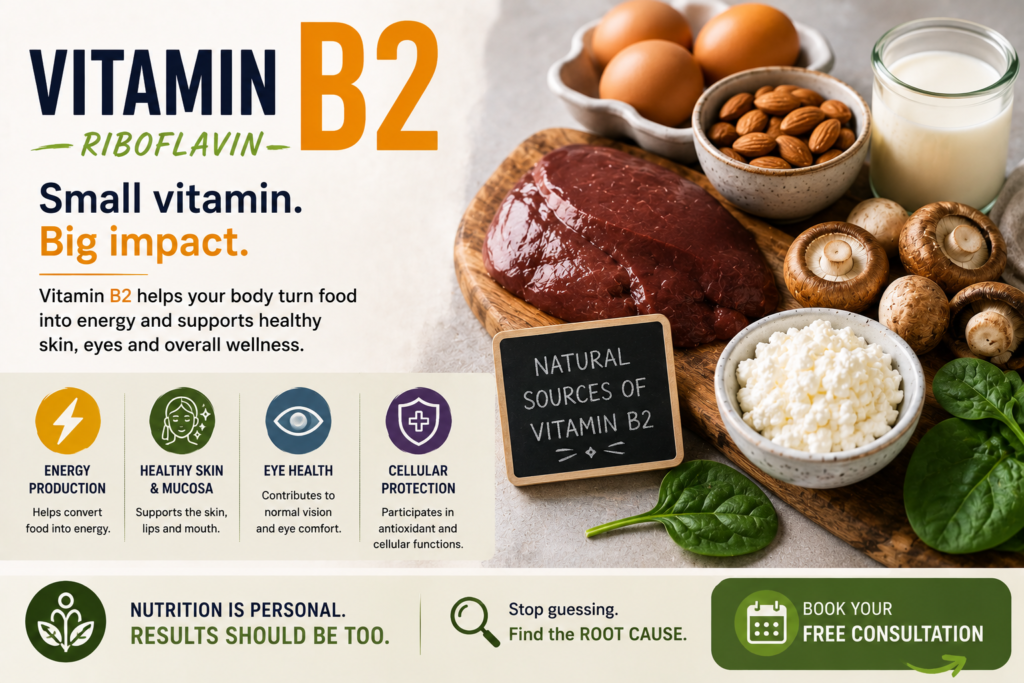
Milk and other dairy products, eggs, meats, almonds, mushrooms, and certain vegetables can contribute riboflavin. Many grain products are also enriched or fortified with B vitamins.
That gives you options.
Someone who eats dairy may obtain B2 differently from someone following a dairy-free or plant-based diet.
The goal isn’t to force everyone onto the same menu.
The goal is to build a diet that actually covers the individual’s nutritional requirements.
That’s a very different philosophy from handing everyone the same supplement protocol.
“But I Take a B-Complex Already.”
This is something worth discussing.
A B-complex can provide riboflavin.
But taking one doesn’t automatically answer these questions:
Why were you concerned about B2 in the first place?
Is your diet inadequate?
Are your symptoms even related to nutrition?
Could another deficiency be present?
Is something affecting digestion or absorption?
Are you taking nutrients you don’t actually need?
A supplement can provide a nutrient.
It can’t tell you why the problem developed.
That’s the piece people often skip.
More B2 Isn’t Automatically the Solution
Riboflavin is water-soluble, and excess amounts can make urine appear noticeably bright yellow.
That harmless color change sometimes gives people the impression that they can simply take enormous quantities because “the body gets rid of the extra.”
That’s not a good framework for supplementation.
The objective of nutrition shouldn’t be: Take as much as possible and let the body sort it out.
It should be: Provide what the body needs while understanding why you’re providing it.
Sometimes food is enough.
Sometimes supplementation has a legitimate role.
Sometimes the symptom you’re trying to address has nothing to do with riboflavin.
Knowing the difference is far more useful than guessing.
Here’s Where the Typical Deficiency Search Goes Wrong
Imagine someone has been tired for months.
They search:
“Vitamin deficiency causing fatigue.”
They discover B12.
They buy B12.
Two weeks later, they read about iron.
Now they’re taking iron.
Then magnesium.
Then B1.
Then B2.
Then vitamin D.
Six bottles later, the original question still hasn’t been answered.
Why are they tired?
That’s the problem with symptom-based supplementation.
It can keep you busy without necessarily moving you closer to understanding what’s happening.
Your body isn’t asking you to collect supplements.
It’s asking you to understand the problem.
Maybe the Nutrient Isn’t the Root Problem
Suppose someone really does have inadequate riboflavin status.
Even then, there’s another question: Why?
Was the diet too restrictive?
Was overall food intake inadequate?
Is there an absorption issue?
Are multiple nutrients lacking?
Has something increased nutritional requirements?
Simply adding B2 may address the immediate nutritional gap without necessarily explaining how the gap developed.
And when health problems keep returning, that distinction becomes increasingly important.
That’s the Approach We Take at Systemic Body
At Systemic Body, our goal isn’t to see a symptom and immediately attach a supplement to it.
We look more broadly through our 6 Root Causes: Nutrition, Toxicity, Alignment, Infections, Emotions, and Mind.
Nutrition might turn out to be an important piece.
But even within nutrition, the investigation shouldn’t stop at:
“Which vitamin?”
We want to consider the overall nutritional picture and the factors that could be influencing it.
Because two people can arrive with similar symptoms and need completely different approaches.
Personalized health starts when you stop assuming everyone has the same problem.
Healthfully,
Systemic Body
Note: I write every post; all this info comes from 10 years of daily testing for my own body.